
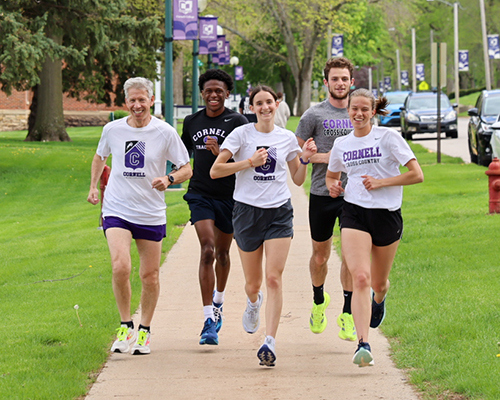
Every morning, before most of Cornell’s 300 employees arrive for work, President Jonathan Brand laces up his shoes and heads out for a run.
His feet typically take him out of town as he runs in silence. He listens to the world around him, to his breath, and to his feet hitting the pavement. Brand often finds himself lost in thought, mostly about Cornell.
“It never stops for him. He’s always thinking about the college,” said Board of Trustees Chair Jan Thomas. “I’ll often get an email when a new idea has struck him. He’ll say, ‘I was out running, and I started to think about this idea for Cornell.’”
No matter the season, he runs five to eight miles every day.
“I just think,” Brand said.
After nearly sixteen years of thinking, the “not fast, but steady” running president is finding a path forward, pushing Cornellians to do hard things, and serving our nearly 175-year-old liberal arts campus in a way that ushers in a strong future.
Brand, who grew up in Highland Park, New Jersey, and St. Louis, Missouri, officially became Cornell’s 15th president on July 1, 2011. With his wife, Rachelle LaBarge, by his side, Brand began his presidency with a trusted partner. He calls LaBarge the “steadying force” who has provided unwavering support throughout his tenure.
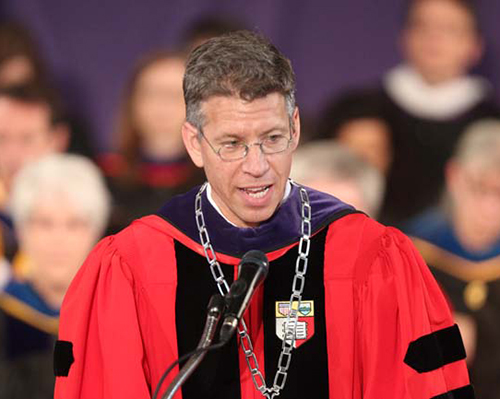
From the beginning the executive team set straight to work, kicking off a formal strategic planning process to keep the college moving forward. During his April 21, 2012, inauguration, he addressed the crowd, speaking of the first strategic plan under his presidency, which was already in the works. It would be called “Re-imagining the Liberal Arts Experience.”
“Cornell is in a unique position to re-examine and re-energize the liberal arts. After all, we have a history of taking appropriate and courageous steps,” Brand said during his inaugural address. “And, we know that the Cornell experience must always enable our students to complete their education on the Hilltop with the intellectual curiosity, creativity, and moral courage necessary for a lifetime of learning and engaged citizenship.”
Over the years, Brand would continue to ponder and work through what defines the liberal arts, keeping it at the forefront of his decisions.
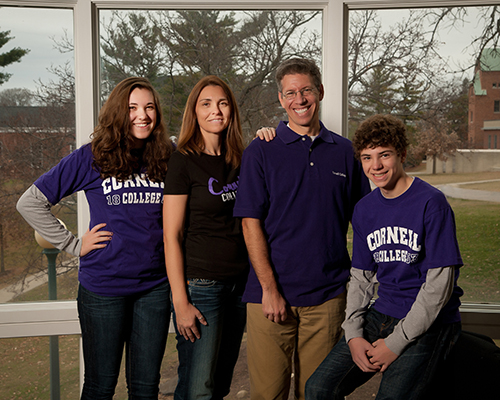
Jonathan Brand and Rachelle LaBarge pose with their son, Ethan, and daughter, Madeleine, for one of their first photos as a family when they arrived in 2011. Photo credit: Rubicon Photo
“I think the liberal arts is always changing. For me, what makes the liberal arts timeless is that it’s a way of thinking. I’d love to see every Cornell graduate become an insightful and critical thinker, an artful and captivating communicator, an ethical and principled decision-maker, and a collaborative and effective teammate. Notice that none of those qualities is tied to any particular discipline. Rather, it’s the collection of their experiences here,” Brand said in 2026, 14 years after that inauguration speech.
Following that first liberal-arts-focused strategic plan, Brand would collaborate with colleagues on two others. He’s now teaming up with Vice President for Student Life and Strategic Initiatives Kate Kauper on the final strategic plan of his tenure as president, which will focus on helping students succeed and complete their degrees. The new plan will set the college’s goals for the next two years and is built on three pillars:
“Jonathan and I are working closely on this plan, which positions the college to strengthen student retention and create a more vibrant and engaging campus experience,” Kauper said. “It’s all about ensuring that the students who are on our campus feel cared for and have opportunities to thrive and grow with each other in community.”
A strategic plan requires buy-in and support from the whole campus. Former President Les Garner says Brand has an incredible ability to focus and has the determination to see his plans through to completion. Garner, who still lives near campus in Mount Vernon, is confident Brand will get all the constituencies, from faculty and staff to alumni and parents, all rowing the proverbial boat together, as he has with previous strategic plans.
“That’s when you succeed. It’s when they’re rowing in unison,” Garner said. “I had a mentor once who said it doesn’t matter if the rowers in the boat have different oars, so long as they row together. The key is to set the tone and the pace. The magic happens when the people’s perspectives come together, and people’s activities complement each other.”
Under Brand’s leadership, that spirit of rowing in unison became more than a metaphor. It translated into a growing endowment and successful fundraising initiatives that improved the campus and expanded opportunities.
The seven-year-long Greater > Than Campaign, for example, exceeded expectations. In the summer of 2022, it came to a close as the largest fundraising campaign in Cornell history. Instead of raising the original $80 million goal, the team brought in more than $118 million. The campaign included construction of the Russell Science Center.
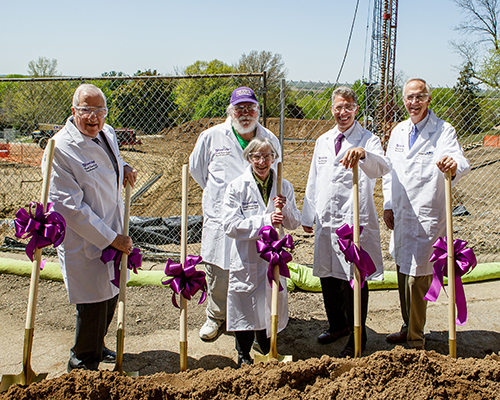
“One specific moment that has really touched me during my 13-year tenure in the President’s Office was the first construction tour of Russell Science Center,” said Executive Assistant to the President RuthAnn Scheer. “We were in vests and hard hats. Knowing what the space would mean for our students and seeing our president and Trustees in that building with that stunning view of Mount Vernon out the windows is something I’ve always felt really proud of.”
That sense of pride is also felt inside the expanded and renovated Richard and Norma Small Athletic and Wellness Center (the SAW), where students work out in the Ririe Fitness & Wellness Center beneath a large purple “C.”
“The SAW has been transformative from a training perspective. Plus, it’s just a happy place,” said Director of Athletics and Head Volleyball Coach Jeff Meeker. “Students love to come here to study and socialize. This building gives us credibility and has made a difference in recruiting.”
The campaign also included projects such as the renovation of West Science Hall, improvements to campus athletic fields, and upgrades to many residence halls. All of the construction work has been done without taking on long-term debt. More than 9,000 donors stepped up to help, many receiving personal requests and visits from Brand. The president also solicited and closed the largest cash gift in college history as part of the campaign: $20 million from Life Trustee Jean Russell ’65.
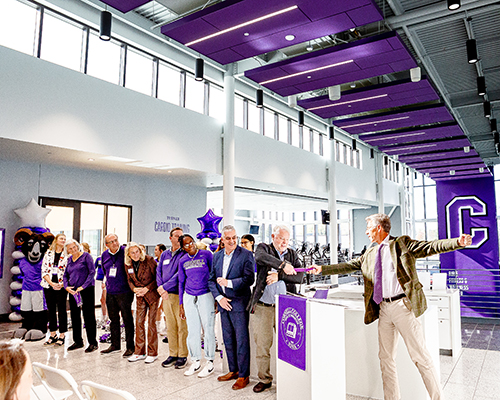
Jonathan Brand participates in the dedication of the Richard and Norma Small Athletic and Wellness Center on Oct. 21, 2022. In place of a traditional ribbon-cutting, donors and Cornellians held a ceremonial passing of the baton. Photo credit: Robyn Schwab Aaron ’07
“Fundraising for a small, private college that had significant capital needs is the equivalent of pushing a boulder up a steep hill, and we know what a steep hill is at Cornell,” said John Harp, retired vice president of Student Affairs and special assistant to President Brand. “There’s no corner Jonathan hasn’t touched with fundraising.”
In fact, according to Vice President of Alumni and College Advancement A.J. Plummer, the advancement team has raised over $202 million under Brand’s presidency, including major support for the endowment, capital projects, and annual fundraising.
“It’s going to be hard to look at Cornell without seeing the successes during Jonathan Brand’s presidency as a key component on the path to Cornell’s overall success,” Plummer said.
Among the clearest signs of that success is the growth of the endowment since Brand’s arrival in 2011. What began as a $64 million endowment 15 years ago has now grown to nearly $140 million in endowment and endowment-like assets as of July 2026.
And he’s not done fundraising yet. Brand wants to leave the endowment at more than $200 million before he says his final goodbyes to Cornell in June of 2027. He says now is Cornell’s time.
“We were desperate for a new science space. We were desperate for a new athletic facility and residence halls,” Brand said. “All of that has been taken care of, which puts us in this really special moment that a lot of other schools could only dream about, where we can say, this is our chance to really focus on doubling, tripling, or quadrupling the endowment—to make sure that the urgent doesn’t get in the way of the important, which is our financial strength.”
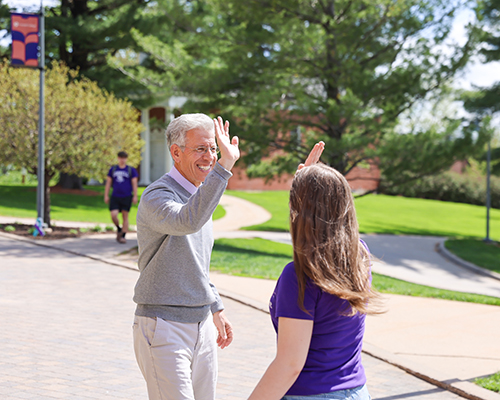
It’s one thing to talk about all the money, numbers, and construction projects, but for Brand it’s about much more than finances. It’s about the students.
When Brand was 15 years younger and just moving to campus, he never realized the parental role he and LaBarge would feel for the students. While they have two grown children of their own, Ethan and Madeleine, they’ve now “adopted” thousands of others who have walked the halls of the college buildings Brand has worked to improve.
“What I didn’t know when I took this job was how much I was going to love Cornell students. Like, I had no idea,” Brand said. “I adore them. They’re incredible. They’re like my children.”
Like any parent—or college president—who cares deeply about the future of young people, Brand channels that commitment into the classroom. Every other year, Brand teaches the block-long politics course Nature, Functions, and Limits of the Law, drawing on his law school background. He smiles thinking about how the room is filled with uncertainty on the first day as the students question what they should call him—President Brand? Jonathan? Professor Brand?
From the classroom to the court or stage, he’s always showing up.
“He’s a cheerleader for all the athletic events, the senior art shows, the Student Symposiums, the musical performances, the theater productions, all of the student groups on campus. He is not only visible, but his presence matters because he’s actually a caretaker of our students,” said Vice President of Enrollment Management Wendy Beckemeyer.
He’s also well known for running with the cross country team, a tradition Brand started at the beginning of his presidency. He admits, though, that he has slowed down a bit over the past 15 years.
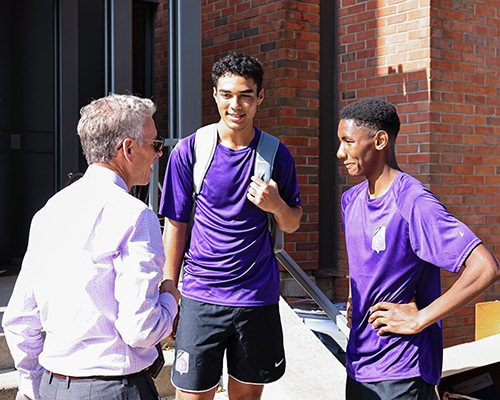
“I’ve entered a handful of races with them,” Brand said with a smile. “I will never forget this one race where I caught up to a few students from other schools, and one of these students looked at me with a mile left in the race and said, ‘So you’re the punishment I get for not training all summer.’”
As director of athletics, Meeker knows the long-running tradition holds special meaning for everyone involved.
“He is not just supporting students at events, but he’s actively engaging with them,” Meeker said. “It means a tremendous amount because it shows our student-athletes that our president understands the work that they’re putting in. It’s always a highlight to say: ‘Hey, our president runs with our cross country team. Does yours?’”
Others feel that support and connection through countless small interactions across campus. It’s the purple Chuck Taylors he wears to Commencement and athletic events, the way he’s high-fiving students on the Ped Mall, and how he’s known for asking faculty and staff members if there’s anything he can do for them.
“Cornell is his happy place,” Thomas said. “He just so deeply loves Cornell. It’s this place. It’s the people. It’s the faculty, staff, and students. He loves the students.”
While he wants to do everything and help every student, he recognizes that not everything goes as planned. Not every decision is one he wants to make. And not everyone will be happy.
Throughout Brand’s presidency, the higher education landscape, the state of Iowa, and the world itself have changed dramatically. The enrollment cliff, a global pandemic, the derecho, economic downturns, budget cuts, project delays, and other challenges have tested all of us. Brand has pushed people to continue moving forward.
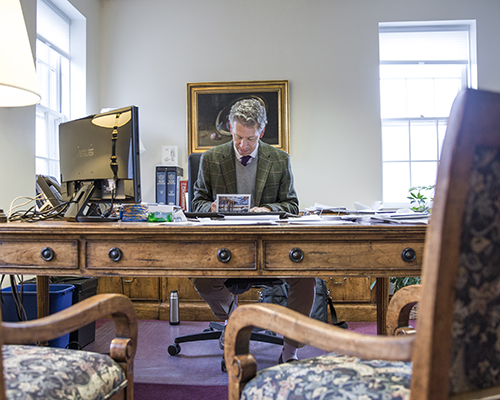 “What I see in Jonathan is a belief in the plan and the need to execute it, certainly to make adjustments based on the environment if things are changing, but not to allow the outside constraints or challenges to derail what we know is the right thing to do,” Beckemeyer said. “And that can be hard because I think the temptation for many people is to run or collapse. To have the bravery to forge ahead and encourage others is a great quality. Whatever we’re facing, whatever challenge it is, he always says, ‘Let’s keep going.’”
Brand has “kept going” nearly three times longer than the average tenure of a college president. Most presidents work at a college for 5.9 years, according to a 2023 American Council on Education survey.
“Could there be a bigger cluster of challenges that a college president has met in the past 15 years? He has helped the college weather this storm, which is not over, but we would have been sunk if there had been leadership changes,” Harp said. “If he had left at some point and we had turned over and turned over again, which is the average, it would have been a disaster. Gaps are created when there’s change like that. Because there weren’t those gaps, and he stuck with it, Cornell has survived—thrived.”
When the pandemic unexpectedly caught many schools off guard, Brand and the entire college leaned into Cornell’s One Course At A Time schedule and found flexibility. The college rolled out temporary summer flex blocks so students with COVID could stay on course for graduation. Other schools looked to Cornell for guidance on a block plan, which proved very useful during the pandemic. When the campus reopened in the fall of 2020, a full plan was in place that included classes held in-person in modified classrooms, in a hybrid format, and fully online.
“I think our COVID response was a really powerful moment for us because we just all came together in a matter of weeks, and we figured out how to keep going,” Brand said. “We had to finish the academic year, that 2019–20 year, but then for the following fall, to be able to offer in-person or hybrid for any student was miraculous. That was, for me, an important, impactful moment because we, institutionally, did what we do really well—we came together in the face of an external threat. And we were miraculous. We were spectacular.”
Just weeks before students were set to return for the fall 2020 semester, though, Mother Nature dealt a one-two punch. Straight-line winds of up to 110 mph blew in during an unprecedented storm, tearing a destructive path through campus and the entire region. Meteorologists referred to it as a derecho or an inland hurricane. In its aftermath, more than 150 campus trees were severely damaged or destroyed, and another 160 were impacted. Twenty main campus buildings sustained significant roof damage. Power was out for more than four days, and with unsafe conditions on campus, the college delayed the academic year by two weeks.
“One of these disasters, much less having them overlap, could have damaged our college if we didn’t have the right leadership,” Harp said. “Jonathan’s calm reserve under pressure, perseverance, and relentless pursuit of answers and resources to keep our college afloat and to help students and employees was heroic. Not only was he applying the appropriate vision and taking in expert information to guide decisions, but he was also doing things like procuring COVID testing equipment before other entities realized they needed it, then personally driving across the state to obtain it. This allowed us to operate the college and help protect our students and employees.”
Years after the storm calmed and the masks came off, Brand began to realize that other shifts needed to happen, and more hard decisions were made in the fall of 2025.
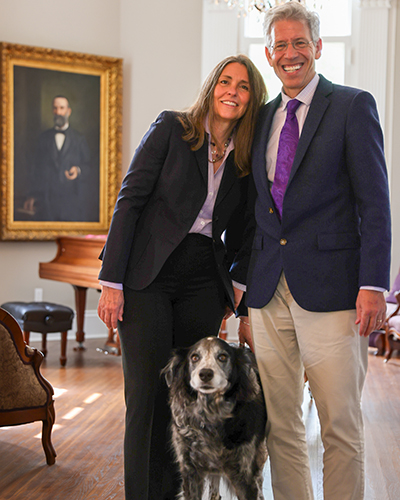
“We have had a challenging stretch at Cornell College—not unlike so many other colleges and universities across the United States—in positioning ourselves for the next 173-plus years. This period has been extremely hard on all of us at Cornell, as we decided in the fall to end several academic programs that many have considered central to our identity as a residential, liberal arts college. The last few months have tested our collective ability to dream and to move forward with confidence. But we must. And we continue to have much to be thankful for and optimistic about,” Brand wrote in his March 2026 White Paper.
Despite the rough terrain, the happy times far outweigh the tough ones for Brand, and he’s already lacing up his running shoes, ready to finish this final leg of his Cornell race.
“Running a college is like a relay race that never stops,” Brand said. “So what do I think lies ahead? I think we can be great with deep honesty about how we can better serve our students—that question never ends—and then having the confidence to change and take risks as we go. That takes courage. My dream for Cornell has also always been to be financially untouchable. So that when the market goes down in the future—and it will, there will always be another recession, depression, who knows, another pandemic, or another demographic cliff—we don’t have to worry about our future because we will be so financially strong that we can weather any up or down. And, that also means that we have the financial foundation and the confidence to continue taking those good risks.”
His commitment is firm, and he’s ready to take on the endowment, teach his final politics class, collaborate on the up-and-coming strategic plan, and make these final six months count.
Ready. Set. Go.