
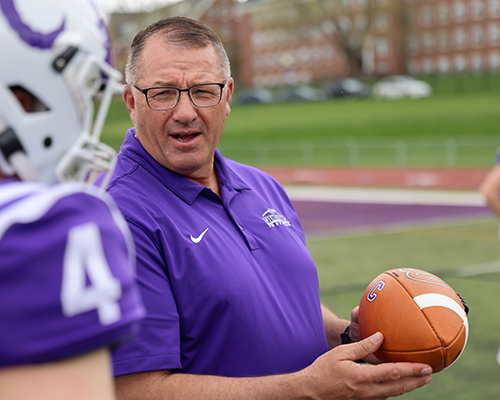
In the fall of 1989 a brand-new football coach, Curt Ritchie, found himself in a bind. A game for his team, English Valleys High School, was scheduled on his wedding day.
So what did he do? He said “I do” and still got to the game in time.
“We had our wedding, then I went to the game, and then we went to the reception,” Ritchie said with a smile.
That’s the kind of dedication Cornell’s new football coach brings to whatever he does. He never misses a game and is fully committed to his team. He knew his priorities from day one at Cornell.
“My first priority was to make relationships with the guys,” Ritchie said. “It really comes down to building a connection with the players, and you can’t build those relationships without building trust. And then the second one was to raise the standard.”
Raising the standard
Ritchie’s focus is on building a winning culture.
“Coach Ritchie knows what he’s doing; he’s built winning programs in the past. Be excited, it’s going to be fun to watch,” said running back Trey Anderson ’27 of Aberdeen, Washington.
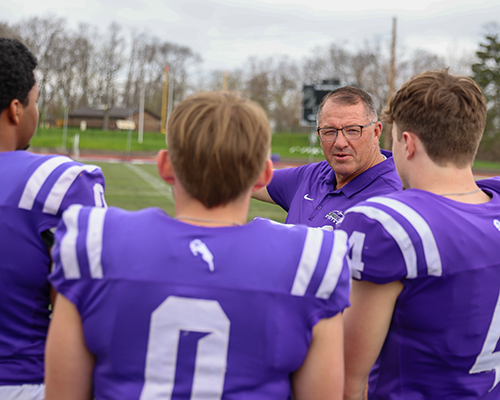 Ritchie came to Cornell with 32 years of head coaching experience at area high schools, including a 24-year run at Williamsburg High School. He led his teams to 23 playoff appearances in the past 25 years, capped by a Class 3A state championship in 2023. He’s racked up 245 career wins as a head coach before coming to Cornell.
So what’s the secret sauce of Ritchie’s strategy?
He builds wins, both on and off the field, little by little. He says it’s all about teaching better habits. For him, it starts with a small piece of paper—a tracking system—for each of his players.
“It’s a daily list that includes completing their workouts, going to class, doing the best they can, getting their work done, tracking their food, and two other personal choices,” Ritchie said. “It’s a way of teaching them that you can either be on a driven path or you can just coast.”
Ritchie says these habits build stronger individuals and stronger players, which translates to a more cohesive team prepared for anything, all year long.
“You have to teach them how to win in small steps, and eventually it grows into other things,” Ritchie said. “When you have developed a driven character on your team, winning on the field will naturally happen because you’ve been used to winning at everything, every single day.”
Building those winning attitudes in class, in life, and on the gridiron builds confidence that they can succeed no matter what the competition brings.
“Coach Ritchie is changing players’ mentalities going into big games,” Anderson said. “In previous years in big games, we have gone into those games knowing we’re going to lose. Even during post-season lifts, the energy is different. People are more excited to be here, and it shows in our numbers in the weight room.”
Finding the difference

The long-time Iowa coach says he’s not like other football coaches.
“Love,” said Ritchie. “That’s probably the one difference between most football coaches and me,” he said. “I don’t believe people jump into a fire to save their family because they’re scared. I think they do crazy good things because they care, you know?”
He uses that caring approach to build the team’s resilience so much so that they will take it with them after graduation and tackle whatever life brings their way. He believes that when the individual develops, the athlete naturally follows.
“It’s just, it’s amazing to see that happen,” Ritchie said.
The team notices the difference too.
“Something Coach Ritchie does that feels different from past years is that he tries to get to know you as a person instead of a football player,” said Joshua Martin ’27, a defensive back from Stanton, Iowa. “I feel a lot closer with the coaches than I have in the past few years.”
One Course At A Time is another difference that helps drive the program’s success. Having worked with several college programs, Ritchie has seen how evening classes and academic conflicts can disrupt practice and frustrate players and coaches. At Cornell, that tension disappears. There’s no class during practice and no practice during class, which allows athletes to stay focused on both.
“It’s one of the reasons I took the job,” Ritchie said. “It’s one reason I think you can recruit and win here, because it’s different.”
Planning for the future
The Rams and the new coaching staff have big plans for the future, including regularly hearing the sounds of Cornell’s victory bell at Van Metre Field at Ash Park.
“Something Coach Ritchie has done is lay out goals for us personally and as a team,” said Julius Jenkins ’27, a defensive lineman from Overland Park, Kansas.
Their goals, among many, include becoming conference champs and ending the losing streak against Cornell’s oldest football rival—Coe College.
The coaching staff is also recruiting a larger team of about 110 players and building the fan base at each game by encouraging alumni, community members, parents, and students to cheer on the team.
It’s a new era of Rams football. Get your tickets now.