
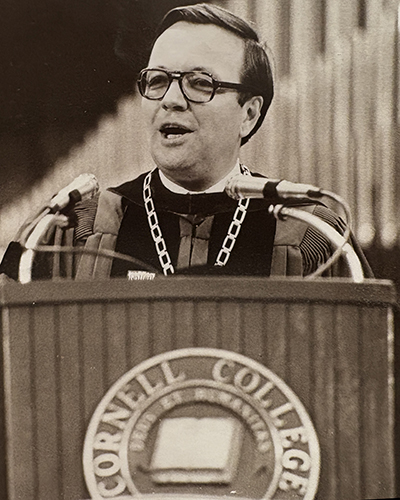
 Philip Secor, Cornell College’s 12th president who led the college during the conversion to the block plan, died on Nov. 20, 2025, in Allentown, Pennsylvania. He was 93.
Secor guided Cornell from 1974 to 1984 during a period of reform and growth. Among the most impactful initiatives during his presidency was the transition from the semester schedule to the block plan in 1978. He also supported greater equality for women through improvements in wage equity and the growth of women’s athletics.
Secor was a successful fundraiser for the college. The campaign at the time, The Cornell Advance, started just months after his arrival and produced about $15.1 million by 1981. It supported the endowment and the growth and renovation of campus facilities. The 12th president was also known for his vision and optimism for Cornell’s future.
Born in New York in 1931, Secor graduated from Drew University in 1953 and served in the Army Medical Corps during the Korean War before earning both a master’s degree and a doctorate from Duke University. Secor taught political science at several colleges, specializing in Soviet politics and law, and authored many books. After leaving Cornell he became the founding president of Philip Secor & Associates, a fundraising consulting firm in Allentown. Secor is survived by his two daughters, a son, and three grandchildren.