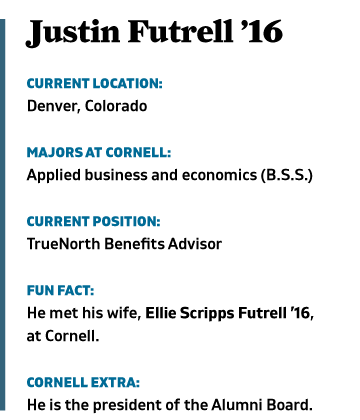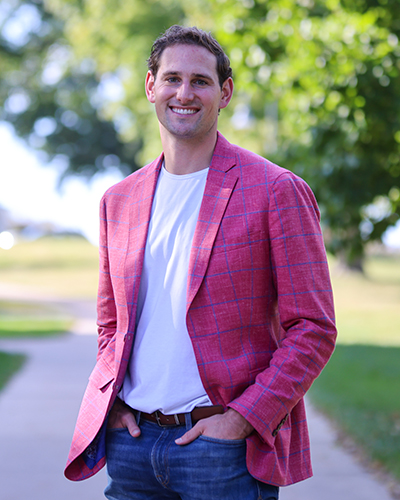
In his senior year at Cornell, Justin Futrell ’16 spent a block in East Africa. Although he always understood the value of community service, that one block reshaped the direction of his life.
“This mother was just out on a walk fetching water, and she bent down where cows and goats had been lying,” Futrell recalled about the off-campus course in 2016. “She had a bowl and drank the water right out of it. It was a gut punch. I’d never seen that.”
Since returning from that experience, Futrell has committed himself to giving back. He and his wife volunteer at shelters, he mentors elementary and high school students, and he builds community through recreational sports leagues. Every act of service only sharpened a deeper calling—one sparked years earlier on that road in Africa. So he created an annual fundraising event for the Tanzania Water Fund. Through his efforts he challenges others to imagine what it means to live with limited access to clean water.
Futrell never forgot what he saw, and he never stopped responding. He turned one moment into a mission.
What does community service mean to you?
Community service, to me, really means paying it forward. I think of all the teachers, coaches, family, and friends in my life who have helped support me when I’ve needed it.
Is there something specific that planted the seed for community service?
The first time I remember feeling that motivation to serve was passing out coffee and donuts at church when I was a kid. Specific to Cornell, it would have been when I took the off-campus class on economic development in East Africa with Professor A’amer Farooqi and the late Dean Riesen ’79. It was a great mix of students. By the end of that class, with all of our perspectives, we all agreed that water is the foundation of everyday life. I remember running into President Jonathan Brand in the airport and saying, “One day I’m going to help people get clean water.”
What project or initiative are you especially proud of?
As part of the Tanzania Water Fund, we help people get access to clean water. We're doing that specifically with a community project of drilling a deep-water well and providing parts for the infrastructure of a solar pump and solar panels. The effort is wrapped into a 12-month community development project where a water council is established, farmers learn the value of irrigation, and teachers instruct kids on the importance of having clean water.
How do you accomplish your goals for this project?
How do you put yourself in someone else’s shoes? That’s the question I’ve asked for years. Each November I do an annual fundraiser called Walk for Water. It gives participants the chance to put themselves in someone else’s shoes. What would it be like if I had to fetch my own water? So, filling up a bucket, wherever you are in the world, and going on a one-mile walk. That’s how we’re raising awareness and creating participation from a place that’s on the other side of the world. The eighth year of the fundraiser was in 2025, and we had a goal of raising $100,000 to help four more villages get clean access to water. Together, we raised $118,000.
What impact have you seen from your efforts?
It’s the stories, the pictures, and the videos. I love hearing stories about mothers who started their own small businesses because they no longer have to walk for four to six hours a day fetching water. And learning about children who had to walk for miles in the morning to fetch water before school, but now they have more energy in the classroom to learn and play. I’ve received a hug from a grandmother who said, “I’ve been praying for this day, the day our village has clean water, for my entire life.”
It made me realize that, yes, this is a fun fundraiser and a fun way to bring people together in the U.S., but it’s incredible to see and feel the tangible impact that it’s making in people’s lives. Now more than 100,000 people have clean water. All of that impact exists because my mentor, Dean Riesen, took the time and energy to lead an off-campus class 10 years ago.
If you could pass one lesson on to the next generation, what would it be?
If I could pass on one lesson from my work, I would encourage people to find something they’re passionate about and find a way to make a difference.
Is there anything else you would like people to know?
Take a moment to think about how often you use water. Really think through your day, from the moment you get up. How would your day change if every drop you used had to be carried by hand? Learn more at TanzaniaWaterFund.org