
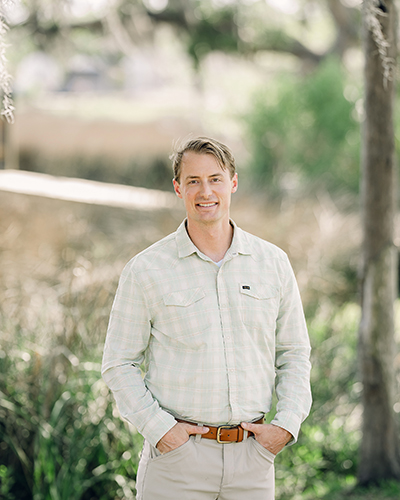
For bird lovers, the phrase “spark bird” describes the sighting that transforms an interest in birds into a passion. The spark for Nolan Schillerstrom ’15 was a red-headed woodpecker tapping out its hard code on a tree behind the Commons at Cornell. “It was almost like seeing a bird for the first time,” he said.
Schillerstrom, who grew up in Downers Grove, Illinois, had been interested in conservation from a young age. He chose Cornell in part because it offered a major in environmental studies, and also because his father, Roger Schillerstrom ’77, was an alumnus. Before his spark bird, Schillerstrom had cared for injured songbirds as an intern at a wildlife rehabilitation center in Illinois.
His commitment deepened. He took a class in ornithology. He received Cornell’s Rogers Fellowship in Environmental Studies, which gave him a summer of work and study at an Audubon Society bird sanctuary in the Beidler Forest swamp of South Carolina. There, he received guidance from the fellowship’s founder, the late John Mark Dean ’58, a noted marine biologist and professor emeritus at the University of South Carolina.
“I’ll always be grateful to Cornell for that opportunity,” said Schillerstrom.
After graduation, Schillerstrom joined Audubon South Carolina in Charleston as a staff biologist, focusing on coastal stewardship, where habitat loss, human disturbance, and other factors are reducing bird populations. He developed a program that trains volunteers to patrol migratory and nesting sites, teaching beachgoers to avoid startling birds while they are feeding and to stay away from sensitive habitats.
“South Carolina’s coastline is a stop on migration routes that are thousands of miles long,” Schillerstrom said. “It’s imperative that the birds not waste time and energy fleeing perceived threats.” He grew especially fond of the smallest visitors—the Wilson’s plover, least tern, and marsh wren. “They are so spunky, proud, and resourceful.”
Schillerstrom was instrumental in securing a $700,000 grant that helped fund the complete restoration of a 32-acre bird-nesting island in Charleston Harbor, which had disappeared due to erosion. Birds such as American oystercatchers soon found the island, followed by least terns, black skimmers, brown pelicans, and more. “At last count, there were 155 brown pelican nests on the island,” Schillerstrom said.
A few years into his career as a staff biologist, he studied nights to earn his Master of Science in environmental and sustainability studies from the College of Charleston.
In 2024, the same year he and his wife celebrated the birth of their first child, Schillerstrom left Audubon to become a conservation biologist with Biohabitats, a private company that undertakes major restoration and conservation projects for government agencies, nonprofits, and other sponsors.
How does he view the future?
“You have to have hope,” he said. “Wonderful work is being done in many places. As a friend once told me, ‘Don’t look at the ocean and be dismayed at its problems. Look to help the fish at your feet.’”