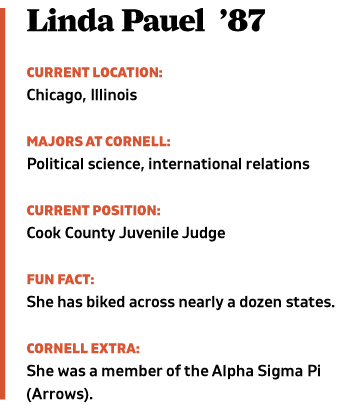
Linda Pauel ’87 grew up in Kingston, Jamaica, with a father who immigrated from Nazi-occupied Holland and a mother of Chinese and African-Jamaican heritage. When she moved to Houston, Texas, as a young child, she watched her mother create a welcoming atmosphere in their home. She learned a valuable lesson that a community is built by respecting people’s differences.
Life on the Hilltop only reinforced this idea. Off-campus courses to Mexico and China broadened her perspective and deepened her cultural awareness. Volunteering at a nursing home with fellow Cornellians showed her that service starts with listening. Living and learning with people from different backgrounds taught her empathy, fairness, and inclusion.
“I learned to look at root causes, not just symptoms,” Pauel said. “Those experiences shaped my commitment to justice in my career and community work.”
Since Cornell, Pauel has advocated for women, supported clients through legal aid and pro bono work, and stayed deeply involved in her community—volunteering in schools, mentoring first‑generation marginalized law students, and teaching new judges about implicit bias. She was elected as a judge in 2014 and has spent the past decade in the Juvenile Justice Division. She handles cases involving minors who commit crimes and says it’s the hardest but most meaningful work she’s ever done.
Pauel’s impact is measured not only by the cases she hears but also by the people who feel more seen, supported, and understood as she works to make justice more accessible for everyone.
What is the root issue you are trying to solve, and why is it important to you?
The root issue I try to address is that too many people, especially children and marginalized communities, are unseen, misunderstood, or mistreated in the courts. I try to ensure that every person who enters my courtroom is treated fairly and connected with services to help them get out of the system. I do this work because I know what happens when we don’t.
In what ways does your work contribute to the kind of world you want to help build?
I want a world where justice and humanity coexist. In juvenile court I try to understand what led a child to a certain point—trauma, abuse, mental health issues—and connect them with resources, jobs, counselors, and mentors. Kids are still developing and need guidance.
More broadly, I want systems that treat people fairly and with dignity. That matters even more now in these times of polarized views and lack of compassion for those who are different. The world I want is one where fairness includes opportunity and understanding. If I can help move the system in that direction, even a little, that’s the world I want to build.
If you could pass one lesson from your work on to the next generation, what would it be?
Don’t assume you know someone’s whole story based on their worst moment. Most people, especially young people, are carrying more than you realize. Most kids who commit crimes aren’t “bad,” they’re overwhelmed. Many are suffering in silence. Most have caring parents who don’t know where to turn. Social media keeps them up all night and makes them feel inadequate. They are growing up in a world that judges them but rarely supports them. Kids feel that. If you listen before judging, you’ll respond with more compassion and better solutions.
What does it feel like when you see the impact of your work on somebody’s life?
This work can be heavy, and you don’t always know if you’re making a difference. When I see a young person doing better, or even making progress, it is gratifying. Some of the most meaningful moments are when a young person I once saw in court comes back years later just to say hello. It tells me they felt seen during a difficult time. That reminder keeps me going.
Can you share a project or initiative that you’re proud of?
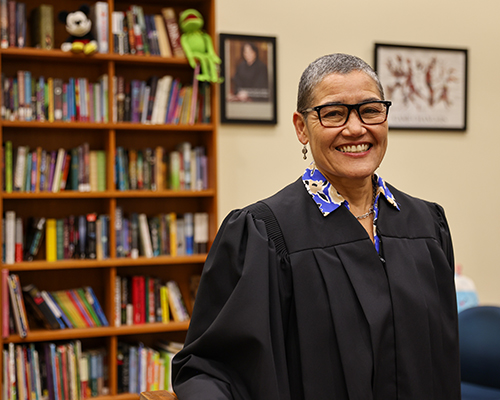
After a child told me he only had one book and couldn’t safely get to a library, I had bookcases installed in the courtroom and filled them with donated books kids could take home or up to the jail. I also created a children’s corner in the courtroom so younger siblings don’t focus on the proceedings and absorb trauma. It allows them to just be kids, coloring or playing with toys. Seeing them relax in that space reaffirmed that small changes can matter.
Did anything during your Cornell years plant the seed for the work you’re doing now?
Cornell was the first place that expanded my worldview and helped me understand my role in it. Politics classes with Professor Dave Loebsack and Professor Craig Allin were a turning point. We talked about injustice, power, and people, not just history. It made me realize that change is possible if you understand systems and speak up.
Women’s Studies with Professor Diane Crowder helped me see inequality in many forms and who gets left out. Cornell encouraged respectful debate and curiosity, which shaped how I listen and learn today. Volunteering at the local nursing home with my social group (Arrows) taught me that service doesn’t have to be dramatic. It can be sitting with someone who feels forgotten.
Cornell taught me to ask deeper questions, look for root causes, and not accept things at face value. Cornell linked learning with empathy and action. That mindset still guides me.
If you could change one thing about how society approaches civic responsibility, what would it be?
I would change the idea that civic responsibility is someone else’s job. Too often we wait for “the system” to fix things, forgetting that systems are made of people. Civic responsibility isn’t just about voting or reposting clips on social media; it’s paying attention and not turning away when something is uncomfortable.