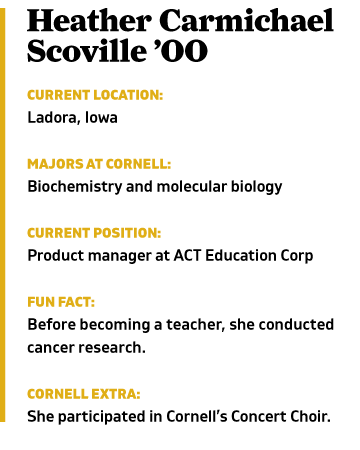
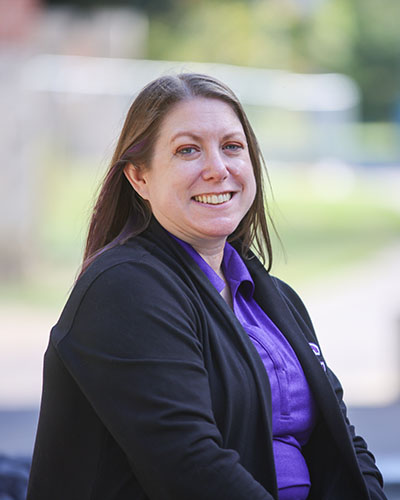
 Heather Carmichael Scoville ’00 learned the impact of giving back when she attended her first Hugh O’Brian Youth (HOBY) Leadership seminar as a high school sophomore. The program’s focus on service—and the idea that one person can spark a ripple effect of change—struck her immediately. Seeing the difference a single individual could make, Scoville realized she wasn’t just inspired by service; she was called to it.
“Community service is how I give back and help others,” Scoville said. “We are stronger when we help others, rather than just looking out for ourselves.”
No matter where her life has led her, service has remained at the center. Scoville has now volunteered for HOBY locally and nationally for 31 years. She logged 371 hours of community service during the 2023-24 academic year and 440 hours the following year.
Her belief in service shows up not just in words but in decades of action. It isn’t just something she does—it’s who she is.
What forms of civic engagement have you been involved in since graduating?
Most of the organizations I volunteer for are related to education in some way. My current volunteering is mostly with HOBY in both Iowa and Illinois. I also volunteer for the Eastern Iowa Science and Engineering Fair (EISEF), the Cornell Alumni Board, and was appointed chair of the ACT giving committee.
How does this work fit into the bigger picture of the world you want to help build?
HOBY teaches leadership skills to high school students. I may be only one person, but if I can inspire others to also become active and give them the tools they need to be successful, a much larger impact can be made. This is also why I became a teacher. I thought that if I could teach others to understand and even love science, I could make a bigger impact and train the next generation of future scientists.
What’s one skill you picked up at Cornell that you now use in your volunteer work?
I think One Course At A Time taught me a lot about prioritization and efficiency. I'm able to do all that I do now because I learned those skills at Cornell.
Did anything during your Cornell years plant the seed for the work you’re doing now?
My involvement in community service started in high school, but it was bolstered at Cornell in multiple ways, starting with the community service projects we did during New Student Orientation. Later, when I joined Alpha Phi Omega—the national service fraternity—I served as service co-chair for two years. The Phi Lambda Xi social group also had a community service requirement as part of membership.
What impact have you seen from your efforts?
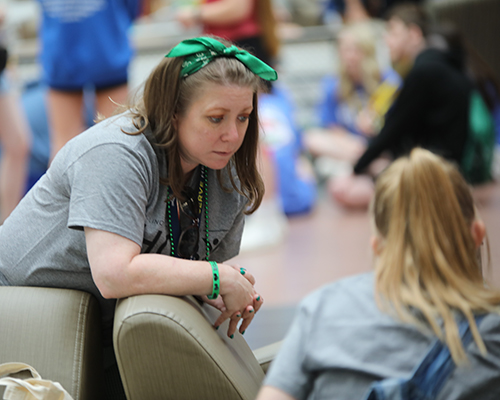
One of my favorite things is following some of our HOBY participants as they become adults. I like to see all of the great things they are doing in their communities and in society as a whole. For example, some of our Iowa HOBY alumni are doing big things, including becoming leaders in nonprofits like The World Food Prize and Civic Nation. For EISEF, one of our fair winners from 2020's project invented a suture that changes colors to indicate an infection in the wound, is affordable to make, and could be used in still-developing countries.
Seeing others making a difference because of opportunities I helped make available to them—in even a small way—is the reason I continue to volunteer. As Hugh O'Brian, the founder of HOBY, once said, his whole goal was to create a "ripple effect" with his organization. By giving the participants the tools and helping them develop the skills necessary to impact their own communities, we can all make a bigger impact on the world. That's what I want to continue to do.
What's one misconception surrounding volunteering that you would like to reframe?
I think there are a couple of misconceptions. First, so many people think they don't have time to volunteer, but you don't have to have huge chunks of time. Many organizations can use help that only takes a couple of hours here and there.
Along the same lines, another misconception is that you have to be out there at events and doing labor for it to be considered community service. There are so many nonprofits that need support that you can do from home, like data entry, creating documents, organizing, event planning, and letter writing. Figure out what you are passionate about, and seek out how you can volunteer to strengthen that area in society.