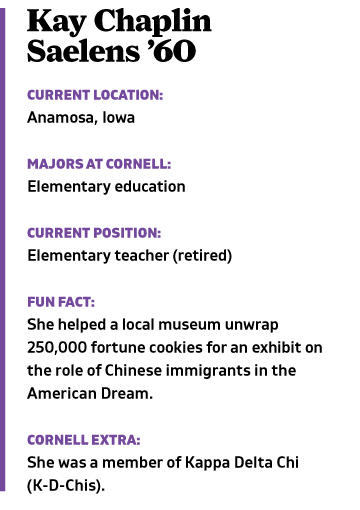
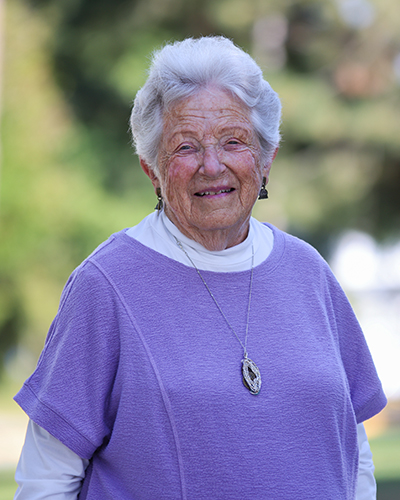
 Kay Chaplin Saelens ’60 hasn’t spent her life giving back to just one organization. Instead, she focuses her efforts wherever she is needed and leaves a meaningful impact.
From the Peace Corps to parenting initiatives, she makes a gift of her time and effort. In doing so, she plays her part in changing the world. When she thinks back on how it all got started, she is reminded of the Hilltop and the lessons she learned early on.
“A Cornell friend once told me, ‘You can be sincere, but you can be sincerely wrong,’” Saelens said. “As one of my activities, would you believe, I once fought to get smoking allowed in our dorm rooms? I was sincerely wrong. I had to be re‑educated.”
The retired elementary teacher held on to that early wisdom. The chance to learn something new—and to have her assumptions challenged—became the driving force behind her lifelong commitment to service. After graduating, Saelens dedicated herself to addressing issues such as cultural bias, prejudice, and youth alcohol and drug use. Ironically, she even went on to advocate against smoking in public spaces.
Her path was shaped by a lifetime of learning and defined by service, proving that informed action can create lasting change.
What does community service mean to you?
Giving back to family, friends, or community, wherever I live, with my time, talent, or treasure.
What have you been up to since graduating from Cornell?
I spent 23 years as a public school educator, which included being a Head Start teacher and working with the Loveland (Colorado) area gifted and talented. I did a Semester at Sea voyage around the world. Over the course of my life, I also participated in the Peace Corps, AmeriCorps Volunteer in Service to America (VISTA), Friends of Children of Vietnam, Friendship Force of Northern Colorado, and served on the YMCA Board of Directors.
What project or initiative are you especially proud of?
When I was in VISTA, I served three years in Alaska. I facilitated a Martin Luther King Day Celebration that provided a meal, a calendar, a poinsettia plant, and speakers, which had more than 150 parents and children in attendance. I’m also proud of the time I worked with another VISTA member on a larger project. We planned and executed economic development projects in 11 Alaskan villages, recruiting, training, and providing ongoing support to develop those communities. Some of the projects were building a community center, rebuilding a fish hatchery, and opening tourist kiosks at the village docks. It was extremely successful.
What impact have you seen from your efforts?
I had the opportunity to return to Belize in Central America after 20 years, following my two years of Peace Corps service there with the YMCA of Belize. Three of the programs I developed—a library story time, an adult tutoring class, and an English as a Second Language program—were still flourishing in a new, larger school compound.
What does it feel like when you see the impact of your work?
It is joyful but humbling when, years later, a parent tells you how much you helped their child learn, or you find out a student has become a teacher.
Did anything during your Cornell years plant the seed for the work you’re doing now?
Two professors stand out for me: Dorothy J. Newbury, my Elementary Education Methods professor, and Walter Stromer, my speech professor. Professor Newbury’s energy, smile, and enthusiasm for relevant learning were a magnet for both children and Cornell students. Professor Stromer, who was blinded while serving in World War II, lived out the belief that one can continue to lead a productive life, even if you have to do things differently.
What’s one skill you picked up at Cornell that you now use in your volunteer work?
There are really three. First, the organization of resource materials. Second, the prioritization of time. Finally, I learned when to say “no” to become and remain an individual.
Who or what influenced your commitment to public service?
My father was the survivor of a dysfunctional family. His self-determination, humor, love of life, and choice to self-educate and become a successful businessman set an example for me as a child. We don’t get to choose our parents, but we do get to choose what we do with our lives. A quote I live by is this: “What we are is God’s gift to us. What we become is our gift to God.”
If you could pass one lesson from your work on to the next generation, what would it be?
You will receive more than you give when you volunteer.