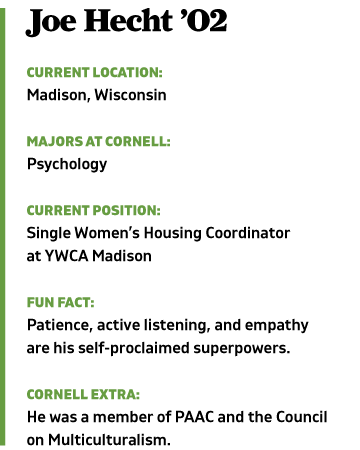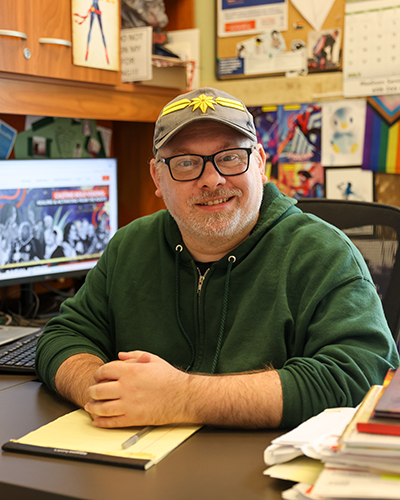
For Joe Hecht ’02, growing up gay in small-town Wisconsin during the 1980s and 1990s put him on a direct path toward activism.
“I had a strong desire to do what I could to make sure that LGBTQ+ youth would have a better and more accepting world to grow up in,” Hecht said. “Over time, my scope increased.”
While at Cornell he participated in Family and Friends, a student organization, and the Intercultural Life Office. Those experiences pushed him to look at how social systems operate in the broader world and how they can fail the people they’re meant to serve. After graduating with a psychology degree in 2002, he dedicated his adult life to creating more equitable communities.
He has assisted people in crisis in many different circumstances: residential care for adolescents, shelters for youth experiencing homelessness and runaway youth, intervention services for domestic abuse victims, and support for people navigating Wisconsin’s state welfare benefits system. He now works as the single women’s housing coordinator at YWCA Madison.
At every stage he stayed rooted in the simple belief that all people deserve care, dignity, and support. Even as his duties continue to evolve, he is sure to be found standing alongside people who need someone in their corner.
What does community service mean to you?
Community service is being an active member of the community you live and work in, helping others who are less fortunate in ways that you are capable, and building a community that is welcoming and accepting of everyone.
What is the root issue you are trying to solve, and why is it important to you?
The root issue that I’m currently focused on is housing. I work to provide stable housing for up to 81 single women at any given time. Housing provides the stability to retain employment, connect with services for basic needs, establish a sense of community, and find support through difficult times.
How does this work fit into the bigger picture of the world you want to help build?
I see ripple effects every day. Residents in my housing program don’t have to worry about having a roof over their heads, which often allows them to set and achieve goals that were previously beyond their dreams. From there, newly stabilized residents reach out to one another to provide support, and supported residents become active participants in the larger community, joining church communities, volunteering for libraries and museums, and attending local cultural events. Some residents strengthen relationships with family members. Some go back to school and pursue new careers.
What impact have you seen from your efforts?
I’ve seen residents of my program stabilize their lives and move into an apartment they never thought they’d be able to move into. Some residents have moved out of my program to become active members of the community, including an artist whose work is getting more and more recognition in the community. I also have residents in the program who are activists and resources within the community, speaking out and providing support for underrepresented voices. The impact radiates outward.
What does it feel like when you see that impact?
I love the community I work in. Despite increasingly difficult times, we’re able to come together and find joy and care. I’m lucky in that I can tangibly see my impact from time to time, or I will have folks make a point of acknowledging my role in their success. It feels good, but it doesn’t feel as good as witnessing the people around me growing, learning to use their strengths, and seeing the positive results of their hard work.
What’s one surprising thing you learned while doing your work?
Every meaningful thing I’ve ever done has started with listening to someone’s story. It can be helpful to distribute food, personal care items, etc., but the real impact is giving someone a voice and letting them know they’ve actually been heard. From there, you can build rapport, discover their needs, goals, and hurdles, and learn what types of help they actually find helpful. That’s where you can partner to help them achieve their goals.
What’s one skill you picked up at Cornell that you still use?
Active listening is the most important skill I developed at Cornell. It really is the heart of any direct-service work. We need to increase and improve communication, look at what seems to be working and what seems to fail, and utilize feedback from participants and those most deeply impacted.
Did anything during your Cornell years influence the work you’re doing now?
The Office of Intercultural Life planted the seeds of coalition-building and introduced me to concepts like white privilege. These seeds continued to grow into a passion for equity and culturally competent approaches to social services.
If you could change one thing about how society approaches civic responsibility, what would it be?
One size does not fit all. Identify and embrace what makes each agency or approach unique and amplify that.