
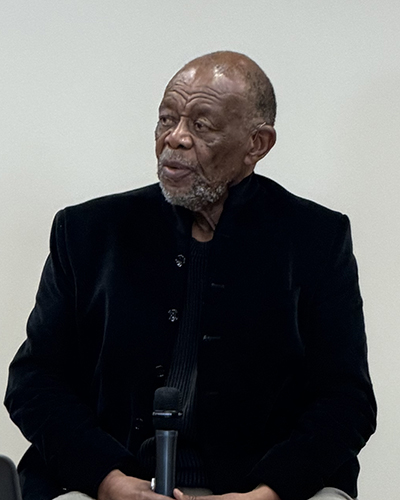
 Internationally recognized South African Poet Laureate and anti-apartheid activist Mongane Wally Serote shared selections from his work and reflected on a lifetime of writing and activism during an Oct. 26 author reading at Cornell College. The event was part of the Visiting Writers Series for the 2026-27 academic year.
Visiting writers have been a part of the fabric of Cornell life for over a century, with poet Carl Sandburg visiting annually from 1920 to 1939. Over the years, many notable writers have visited Cornell, and Professor of English and Creative Writing Rebecca Entel, director of the Center for the Literary Arts, said the program benefits far more than English and Creative Writing majors.
“Through such a program, students can come to a small college and still be exposed to writers and thinkers with a vast array of personal and professional backgrounds from all over the world,” Entel said. “Our events are also open to the public, which enriches the cultural life of Mount Vernon and surrounding communities.”
The event was held in the Hall-Perrine Room in the Thomas Commons. Over the course of an hour and a half, Serote read selections from his writing and answered questions from the audience about his work as an activist. The author of more than 20 books of poetry and fiction, he is currently the National Poet Laureate of South Africa. He also served in parliament during Nelson Mandela's presidency in the historic post-apartheid government of the 1990s.
“Mr. Serote's visit gave our students a chance to hear the new poetry of an important writer they might not otherwise encounter and an opportunity to learn about a pivotal historical period relevant to our own. He became politically active when he was our students' age, which is instructive for them,” Entel said. “It is an honor for Cornell College to be a part of Mr. Serote's select U.S. tour commemorating 50 years since the Soweto Uprising and the publication of his new epic poem, ‘Listen.’”
After his reading, he took questions from the audience. Audience questions ranged from Serote's experience in solitary confinement as a young anti-apartheid activist to poetry's role in political change.
“It must have been after two months or so that I became friends with ants,” Serote said. “Because those bars and walls that kept me in could not keep them out. I would talk to them and thank them for coming and to please come back when the light returns.”
He also spoke of the rhythms of their imprisonment; how he would know what time it was by the things that were happening outside his cell.
“Every day around 3:00–I don’t know how I knew it was 3:00, but it was 3:00–I would climb on the blankets and look, and prisoners would arrive. They had to undress and become naked, and they would go into the shower,” Serote said. “I knew when the sun was at a certain spot I had to climb on the blanket and look.”
Another audience member asked what poetry contributes in times of political dissent. Serote explained that poetry is what allowed him to understand what was going on and understand the world around him.
“It was popular because I had taken the voice of the people and put it in the public. I showed how they understood the way the world works. We demanded that the world understand that we are human and poetry showed that humanness,” Serote said. “Poetry is a mirror that you put before yourself, before the people, and, if possible, before the world.”
Community member and alumna Dee Ann Rexroat ’82 was happy to be back on campus for this event.
“As an alumna, I feel proud that Cornell College continues to host nationally and internationally renowned speakers and writers who can inspire our students,” Rexroat said. “My husband and I attended and were pleased to see students engaging with Mr. Serote afterward.”
Serote's visit marked the second appearance by an international writer on Cornell's campus this semester. It was co-sponsored by the Coe College English Department and the Mount Vernon Area Arts Council, a collaboration that could lead to additional joint programming in the future. For other events hosted by the Center for the Literary Arts, check out the Cornell College events calendar.