
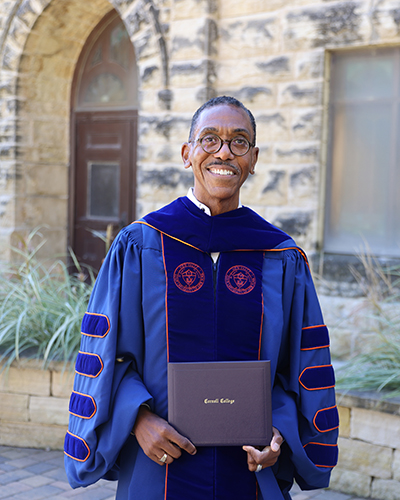
 Darrell Wheeler ’81—HIV researcher, educator, and leader in the field of social work and marginalized communities—received the 2026 Distinguished Achievement Award during Homecoming Weekend. It’s the highest honor awarded by the Alumni Association and the college.
He graduated from Cornell in 1981 with a degree in sociology and began a journey that would take him from the Hilltop to some of the most influential positions in higher education, public health, and social work. Along the way, he earned graduate degrees from Howard University and the University of Pittsburgh, served in the United States Air Force, conducted groundbreaking research, and became a leader whose work has influenced health policy and the lives of countless people.
Much of Wheeler’s career focused on health and mental health disparities, particularly HIV and the health of marginalized communities. Major federal agencies have supported his research, and his expertise led to service on the U.S. Presidential Advisory Council on HIV/AIDS and the Office of AIDS Research Advisory Council, where he helped shape national priorities for research and public health.
As president of the National Association of Social Workers, Wheeler led an organization representing more than 150,000 professionals and gained a national and international platform to advocate for social work and the communities it serves. He taught and held leadership positions at institutions including CUNY, Columbia University, the University of North Carolina at Greensboro, the University at Albany, Loyola University Chicago, and Iona University. In 2022, he became president of SUNY New Paltz, making Wheeler the university’s first Black president.
He has mentored students and researchers, supported the development of underrepresented scholars, advocated for communities whose voices have too often been overlooked, and devoted his career to preparing the next generation of leaders, using his scholarship to advance knowledge, his leadership to improve institutions, and his experience to help prepare those who come after.