
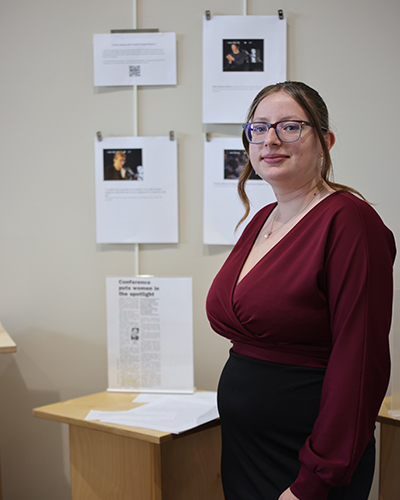
Sophomore Rozella Liggett ’29 set out to understand Cornell’s connection to feminism and women’s rights activist Gloria Steinem during her Block 1 Second-Year Seminar, Archival Quest, with Professor of English Katy Stavreva.
At a time when the country learned of Steinem’s death on Sept. 2, 2026, Liggett was just getting to know about the feminist leaders’ April 15, 1999, visit to the Hilltop. Liggett released a podcast with her findings, “Gloria Steinem and Cornell’s Feminist Foundations,” which explores what Steinem fought for and how it still applies today.
For the project, Liggett spent time in the Cornell Archives to better understand all the key players. She started by learning more about Professor Emerita of French and Women’s Studies Diane Crowder, who, along with the late Professor Emerita of Sociology Charlotte Vaughan, created the women’s studies program—a program still around today, known as gender, sexuality, and women’s studies.
“Cornell has made it possible to hear so many voices, even if they were considered controversial at the time,” Liggett said. “This was also aided by the founding of the Women’s Studies Program and Diane Crowder fighting for equality for everyone on campus.”
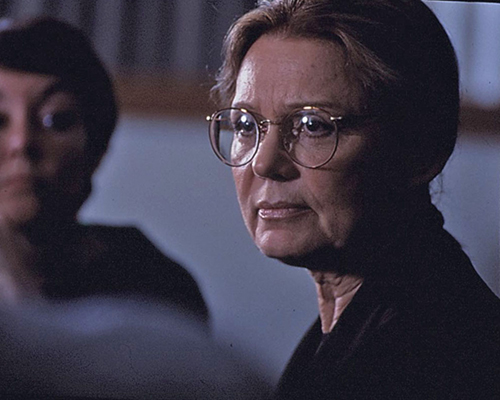
From there, Liggett also discovered that Helen Damon-Moore’s connections with Steinem brought her to Cornell to speak. Damon-Moore was an instructor in education and women’s studies and director of volunteer services and service learning. The Cornell Sophomore from Illinois also watched a digitized version of Steinem’s 1999 speech in King Chapel, “My Role in the Women’s Movement.”
Plus, her research revealed a list of other feminist speakers who have spoken at Cornell, such as Elizabeth Cady Stanton (1869), Susan B. Anthony (1879), Betty Friedan (1977), and Shirley Chisholm (1982).
“It was amazing to see how many famous female activists we had on campus and how they kept fighting for what they believed in,” Liggett said.
After finishing the block and learning about Steinem’s life and visit to Cornell, Liggett said it reinforced her beliefs that it’s important to bring awareness to what matters to you.
“To be a Cornellian is to advocate for what you believe in by asking yourself, ‘What issues matter to me and how can I solve them?’” she said.