
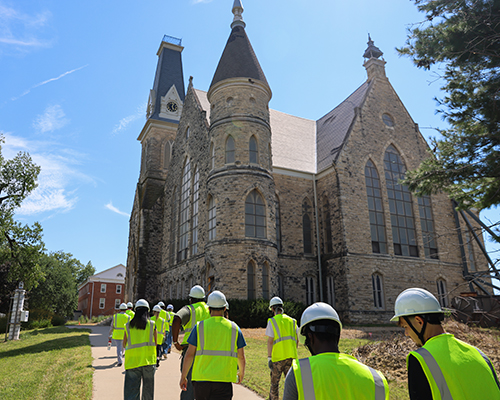
 King Chapel has been closed since the 2020 derecho, but some students are getting a peek inside as they contribute to research ahead of the restoration process.
While the college waits for state and federal agencies to complete their reviews and allow repair work to begin, a group of 16 students suited up in safety gear to explore the inside of the building for their Second-Year Seminar class, Modern Art Museums, during Block 1.
Cornell’s Construction Project Manager Beth Orth led them on a tour, discussing the architecture of the 1882 building.
“The archives already have information on the memorials of the windows, so if you could find out the other symbolism and dive deeper, that’s what we are looking for,” Orth said as she guided students around.
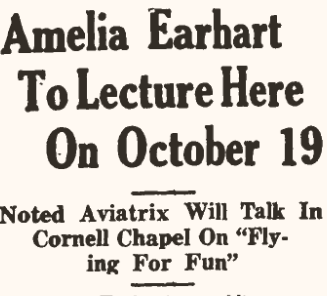
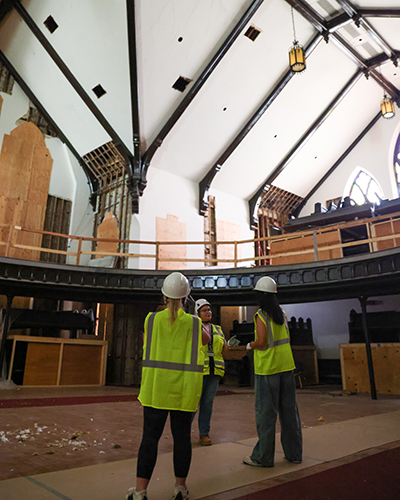
The inside of King Chapel looks different than what some alums might remember. The pews and seating have been removed, and many areas have been boarded up. Still, the magic of the old building remains, visible in the colorful windows and tall arches. The empty stage still seems to hold the whispers of those who spoke over the last century, such as Martin Luther King Jr., Frank Lloyd Wright, and Amelia Earhart.
The SYS class, taught by Assistant Professor of Art History Michael Feinberg, focused on the study of museums and their evolving role in society. Students learned about museum operations, exhibitions, and potential career opportunities in the field. Then, the class divided into small groups to curate an exhibition on King Chapel—choosing their own topics.
“I want students to learn effective research and communication skills,” Feinberg said. “At the same time, I hope King Chapel helps students acquire a more complex understanding of the history of Iowa, Mount Vernon, and of course, Cornell College. I also hope that the community can use the exhibition to feel more connected to a historic building that has defined life at the college for more than 140 years.”
The research
The student teams went to the Cornell archives in the library, dug through yearbooks, and read through old issues of The Cornellian. They also had the opportunity to go inside the building twice.
“Our group’s focus was on the Mount Vernon and Cornell community’s use of King Chapel,” said sophomore Wesley Haynes. “King Chapel stands apart from every other building here, and we questioned what the building means for everyone.”
Sophomore Java Johnsen enjoyed seeing what unfolded inside the building over the past 140 years, including the visit by MLK, performances by the Chicago Symphony Orchestra, and a drag show.
“Everything was definitely a lot more community-wide, with campus and the town coming to events. I found it interesting, also a little hopeful,” Johnsen said. “That really sells the importance of King Chapel to me.”
Other students focused on the Gothic architecture, music over the years, and the stained and painted glass windows.
 Behind the collaboration
The partnership between Orth and Feinberg began taking shape over the past year. Both were new employees at Cornell and frequently attended employee welcome events together, where conversations about King Chapel transitioned into discussions about how students might contribute to its future.
“From my perspective on the construction side, there’s history that we have the opportunity to get right now that we’re not going to have the opportunity to gather in the future when construction is taking place,” Orth said. “And so we could pay an architect or a consultant to come in and do it, but after talking with Michael, we realized his class could be very helpful and gather that information.”
Feinberg was eager to use his skills as an art historian to fulfill this need on campus, while also giving students a unique hands-on research experience. At the end of the course, the students presented their findings at the SYS Symposium. For Feinberg, the project gave students a chance to connect with an important part of Cornell’s history while putting the citizenship goals of the SYS curriculum into practice.
“Citizenship entails honoring the shared culture and history of the community,” Feinberg said. “Our class’s exhibit pays homage to the rich history of King Chapel, including how it has functioned as a physical place for the community to gather. Students were able to meet the need for more research on the chapel’s history and design features. At the same time, the students’ exhibition also reminds the broader community of the catalytic role the Chapel has always played in shaping the college’s values.”
From the past to the present, the iconic building has been part of the lives of thousands of Cornell alumni and Mount Vernon residents. While only a small number of students have been in the building recently, the construction team looks forward to a future when a restored King Chapel once again becomes a part of every student’s Cornell experience.