
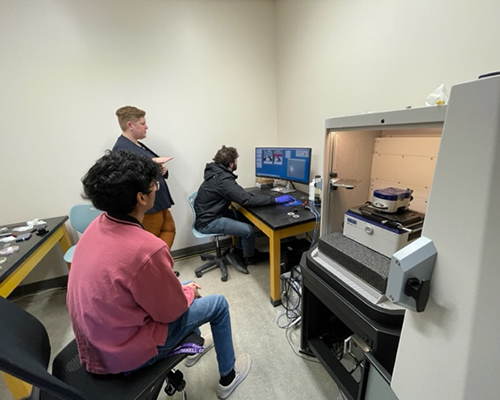
A group of Cornell College students and their professor have discovered surprising results in their research on antimicrobial peptides, which are being studied as a method of combating antibiotic resistance. These peptides, part of the innate immune system, could be used to kill bacteria on their own or to create channels for other antibacterial drugs to enter bacteria.
“Antibiotics are overused, which has led to bacteria becoming antibiotic-resistant, so looking into other treatment methods is vital,” said senior Sophie Stumbo ’27. “That’s where this research comes in, figuring out how an antimicrobial peptide, Magainin 2, forms pores in the cell wall of bacteria and how that affects the cell.”
The researchers found that when exposed to high concentrations of the antimicrobial peptide, bacteria became more rigid instead of softer, contradicting previous assumptions.
Stumbo, along with Ryan Zurick ’24, Jonathan Azenon ’24, Jonathan Raper ’26, and Associate Professor of Biochemistry Catherine Volle, published the results in the February 2026 “AppliedPhys” journal, “High Concentrations of Antimicrobial Peptide Magainin 2 Induce Distinct Biomechanical Changes in Escherichia coli.”
“One of the things that sets our research apart is that we aren’t looking at how the antimicrobial peptide is working because we know what it does,” Volle said. “We’re looking at how the bacteria are responding to these different concentrations. Finding that there was a completely different biomechanical response was surprising.”
The team used the well-studied E. coli bacterium in their research, testing how it responded to the antimicrobial peptides at low, medium, and high concentrations, with the high concentration being a vital part of the study.
“If antimicrobial peptides, like Magainin 2, were to be used in a clinical setting to help fight bacterial infection, much higher concentrations must be administered to ensure that bacterial infections are well fought off,” Zurick said.
At the high dose, the student researchers expected the magainin to form pores in E. coli and make it more “squishy.” However, instead of getting softer, the cell became more rigid, and the cell sealed itself off from larger molecules, which would make any kind of co-treatment with additional antibiotics ineffective.
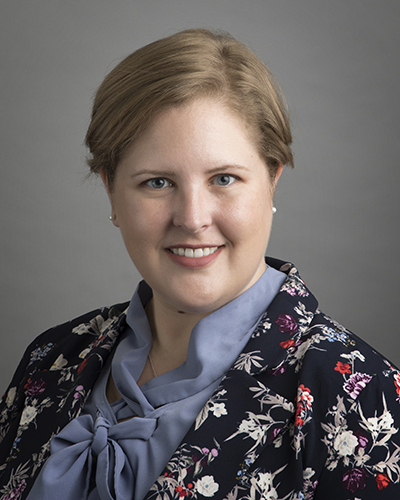
“You can imagine if you poke a bunch of holes in a basketball, it’s going to get squishier,” Volle said. “That’s what happens with bacteria when we treat them with these lower concentrations of antimicrobial peptides. They stay stiff for about five or 10 minutes, and then they get real squishy. However, when we treat them at high concentrations, we see that instead of getting squishier, they become stiffer. So it’s like if we overinflated that basketball, it gets bigger and much harder.”
The team says it’s important to better understand how bacteria respond, especially given interest in using antimicrobial peptides in clinical settings, either alone or in tandem with other antibacterial compounds. They caution that much more information and research are needed before scientists can say that antimicrobial peptides could serve as a new antibiotic.
“If we could understand the right concentration of Maganin 2 to drug ratio, we could create an effective therapy for bacterial infections,” Azenon said. “This is really crucial because of the increase in antibiotic-resistant infections across the globe. Antibiotics, our old trusty solution, can no longer be the solution. Bacteria are evolving past our only line of defense, and we need to evolve our weapons or face the scourge of infections again.”
It’s a tricky balance of gathering data and figuring out how to apply it to patients within the healthcare world.
“I think it is important for the general public to understand this research because it demonstrates just how complicated it is to develop new ways to kill bacteria, even when you have a promising avenue,” Zurick said. “Just because we have a category of peptides that seem to generally be very effective at killing bacteria, doesn’t mean that our understanding of them will translate well to clinical settings.”
Behind the research
The work for this paper started in 2024, with Zurick and Azenon collecting data during a block-long, research-intensive capstone course, and continued with Zurick, Azenon, Stumbo, and Raper working on the project during the Cornell Summer Research Institute (CSRI). They worked with an atomic force microscope in Russell Science Center, which is an instrument Volle says is uncommon at a small college. They also gathered data using a fluorescent microscope and fluorometer.
It was a hands-on research opportunity that inspired the students in many ways.
Zurick, for example, is wrapping up his post-baccalaureate research fellowship at the National Institutes of Health and has accepted a Ph.D. position at the Max Planck Institute for Molecular Cell Biology and Genetics in Dresden, Germany, where he’ll start in the fall.
“I gained a lot from the research experience,” Zurick said. “For starters, it was my gateway into a career in research. With the immersive environment of being in the lab every day on the block plan, I decided that I would try out research, and that's when I joined the Volle lab. Being in this lab showed me what the everyday life of a research scientist looks like, and I fell in love with it.”
Azenon is working as a microbiologist at Element Iowa City. He says that learning science on the One Course At A Time schedule, with the dedicated professors at Cornell, prepared him to conduct science in the real world. Now he’s putting his degree to work, even though he jokes that sometimes his work takes more than 18 days.
“We have a program called SENTRY,” Azenon said. “For the program, we ask hospitals from around the world to send us ‘interestingly resistant’ samples they see in their labs. We then track that resistance data and build a library, which is one of the oldest in the world, going as far back as 1997, for a whole range of projects. I feel like my work in CSRI and in the Volle lab has definitely prepared me for the role I am currently in.”
Stumbo, who will be a senior next year, is taking her experiences with her on a new adventure this summer.
“I’m very thankful to Catherine for taking me into her lab as a freshman and for all her help since then—both in class and in helping connect me to some awesome internship experiences,” Stumbo said. “I will be doing lab research in Venice, Italy, this summer, and that wouldn’t be possible if she hadn’t recommended me for the position. I'm excited that I get to do my senior capstone project with her next year, and return to similar work that I got to do as a freshman.”
Volle is proud of this research and the work her students did. She says it’s very rare to be listed as an author on an academic paper as an undergrad. She knows these students will go far. Meanwhile, Volle is already planning the next steps in the antibiotic-resistance studies at her Cornell lab, which will take place this summer through CSRI.