
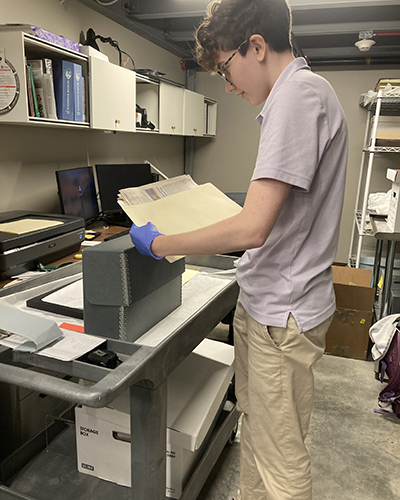
Orion Pevehouse ’26 leaves Cornell with a full slate of graduate acceptances—every program he applied to offered him a spot. It’s a reflection of the dedication he brought to his studies on the Hilltop.
This fall, he’ll begin his master’s program at the University of Illinois Urbana‑Champaign, the nation’s top school for library and information science.
“Funnily enough, Cornell wasn't originally on my list of places to look at. I came here because a friend of mine who I was touring schools with had Cornell on her list,” Pevehouse said. “I toured Cornell with her and the more I stayed here, the more I thought I could get behind this; this place is cool.”
Drawn by One Course At A Time, Pevehouse does not regret his decision to become a Ram.
“I have a hard time focusing on a lot of different things at once, so it was nice to just help me focus on my studies and not have the anxiety of having to focus on so many things,” the Madison, Wisconsin, native said.
While on campus, Pevehouse got involved in Chess and Games Club, Students for a Democratic Society, and the Cornell Historical Archaeological Society. It was, however, an internship in the summer of 2025, working with Curator Felicite Wolfe at the African American Museum of Iowa, which had the greatest impact on what he wanted to do with his life.
“I knew I wanted to do something in the museum realm, but I wasn't entirely sure what that was going to be,” Pevehouse said. “Originally, I thought, I can just be a curator or jack-of-all-trades. But my internship was far more specific. Most of my time I spent in the actual archives of the museum, and I spent time cataloguing things. I just had so much fun. It was honestly really sad when I left the internship.”
Over the course of his internship, Pevehouse combined the knowledge from his American history major and his art history minor to catalogue images, papers, and artifacts, as well as working the front desk, answering phones, and even processing an entirely new collection.
What started as more than ten cardboard boxes of loose, disorganized papers and photographs became an organized collection of artifacts about the first Black mayor in Iowa, LaMetta Wynn. Elected as the mayor of Clinton in 1995, Wynn’s collection included letters she received while in office, records and notes she kept as a nurse starting in 1963, and other artifacts collected over what Pevehouse said was an incredibly rich life.
“History seems so much more tangible when there’s something you can hold in your hands,” Pevehouse said, “rather than just reading a chapter in a book or an article in the newspaper. But going through her things, you have something in your hands to be able to say ‘this person was here’ and ‘here’s what I know about them.’ Here’s what they left behind.”
He’s fascinated by how small differences in old photographs can reveal forgotten stories and help rebuild an image of places long changed or gone. Even the smallest variations in old photographs can reveal pieces of history that no textbook has room to hold. It motivated him to create a collection that would pass this experience on to future generations.
“People like Orion are rare stars indeed. He has a gift for creative empathy, and a winsome and disarming personality that enables him to connect with others in meaningful ways,” Professor of History Catherine Stewart said. “The field of library and information studies and archives is in need of more passionate, thoughtful, and ethical individuals like Orion, who value the histories that have not been as well-preserved or told.”
The internship also helped him narrow down where he wanted to go after he left Cornell. Spending so much time in the archives of the African American Museum of Iowa led him to realize that archival work and collection creation are where he wants to be. He also believes this invaluable experience was the reason he got into all four of the graduate schools he applied to.
“Nothing bad will ever come from trying something. The experience is so much richer than getting paid for a summer job,” Pevehouse said. “And if you’re curious about something? Go the extra mile. Just try it.”
Although the internship clarified his path, Pevehouse says he wouldn’t have reached that point without the people who shaped his academic voice–the exacting, “absolutely phenomenal” history faculty who taught him how to read the past, and the Dungy Writing Studio that helped him learn how to write about it.
“One thing I want to share with students and potential students is that college is really what you make of it. If you had asked me four years ago if I envisioned myself doing this, I would have told you you were crazy. When I first came here, I wanted to do psychology, but I never took a single psychology course because I fell in love with history,” Pevehouse said. “So just keep an open mind. Believe in yourself, believe in your abilities, and ask for help if you need it. It’s going to be great.”