
Woven fabrics have existed for thousands of years and have sparked revolutions, powered economies, and transformed cultures. This summer, two Cornell Summer Research Institute (CSRI) students are uncovering those global threads to support a new Cornell history course.
Watch their CSRI research unfold in this video:
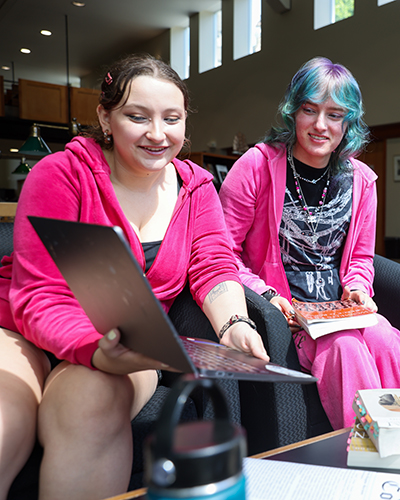
Working under the guidance of Professor of History Michelle Herder, Aslan Baker ’28 and Kat Maurelli ’27 are conducting original research on how textiles functioned as evidence of status, trade, and technology across centuries—work that directly informs the next iteration of her Threads of History course. Because the course is still evolving, the student researchers are helping identify the most current discoveries, activities, and artifacts that make textile history more vivid and accessible for future classes.
They have spent the eight weeks of CSRI exploring a variety of activities together. Starting with an examination of the Bayeux Tapestry, they have been following new threads of inquiry by reading texts, visiting museums in person, trying out potential projects to incorporate into the class, and viewing artifacts through online museum databases.
“We've been looking a lot at different bigger museum collections; museums in England, along with The Met,” Maurelli said. “They have really, really good collections that they've been able to scan in or take really detailed photos, so you can even see thread structure.”
Their museum visits and artifact study are an important part of the research process as they identify examples that illuminate how textiles functioned as evidence across cultures. Baker, a history and studio art double major, was eager to be selected for this project. Not only does he love being on the beautiful campus with a community of productive people, but this research lines up with his future career goals.
“I was interested in this project specifically because I loved taking Michelle Herder’s course my freshman year and art in history is my thing,” Baker said. “I would love to work in the museum industry. I'm interested in the conservation of textiles, artwork, public history, and memory.”
Rising senior Katherine Maurelli ’27 offers a similarly woven perspective. She previously took Herder’s class and is completing a B.S.S. in fashion and textile history, along with a minor in art history.
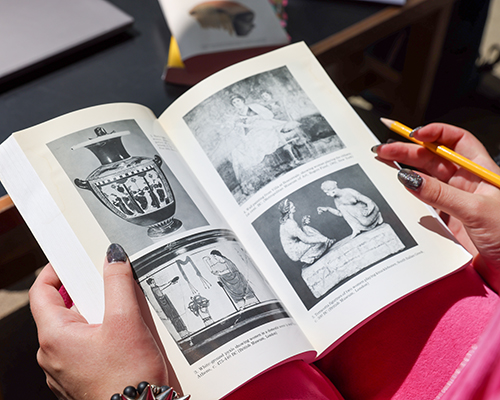
“We've been looking at sumptuary laws, which are laws that restrict what people wear, and then looking at pictures and actual artifacts that represent what we've been learning,” Maurelli said. “A lot of times fabrics degrade over time, so there's not a ton of them that we can use as actual evidence.”
Since Herder had already had both students in class, she was confident that they’d be able to work independently and be highly motivated for the project. Herder said the students’ research is essential to shaping the next version of the course, helping her identify examples that make textile history vivid and evidence‑driven.
“They've been great. They are clearly so enthusiastic,” Herder said. “They like finding their own adventures. They're really pursuing their interests and finding their own path through this and really digging into the material exactly how I'd hoped for. It's really going to help me in my work and the work of continuing to develop this course. ”
For Baker, this adventurous spirit led him to take a solo visit to the Putnam Museum in Davenport.
“It was completely empty when I got there, so I got to get really up close and personal with the exhibits,” Baker said. “They had two mummies on display, which is wild. I got to see the linens and the structures up close. It was pretty cool.”
Maurelli, meanwhile, has stitched her love of crochet into the historical evidence they uncovered on lace‑making patterns in the books and articles they’ve been reading.
“I personally have a really big interest in lace making, so I was able to find some examples of lace-making patterns, but there are no photos of them. It's just evidence that they exist,” Maurelli said. “So that's been my project that I'm excited about, to see if there's physical evidence of these lace-making patterns.”
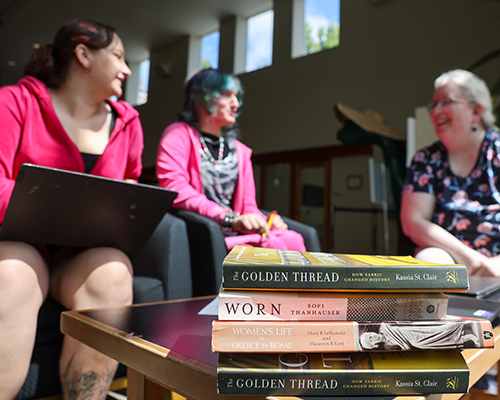 The entire team was happy that funding for CSRI existed. Baker says it's meaningful to dive deep into the books they're exploring and take adventures off campus.
“It helps us develop these activities in the classroom to make cool experiences and meaningful experiences for future students, too,” Baker said. “Personally, I think it is helping me develop more confidence in myself—academically and professionally—learning to maneuver my way through situations on my own.”
Maurelli also pointed out the importance of students getting hands-on experiences during CSRI while still being in a familiar place with familiar people. She said it’s an opportunity students shouldn’t overlook.
“This has been a really great chance to kind of look at different topics that I might be interested in expanding on my thesis or looking into for grad school,” Maurelli said. “My dream job would be working in museums, doing research on textiles or helping do some curation on textile and fashion exhibits.”