
Cornell College’s Mahmoud “Moodi” Elawady has been named a recipient of the prestigious $36,000 McElroy Fellowship.
Elawady, who is from Deyarb Negm, Egypt, graduated summa cum laude from Cornell in May of 2026 with dual B.A. degrees in biochemistry and molecular biology and computer science. He plans to pursue a Ph.D. in neuroscience at the University of Iowa this fall.
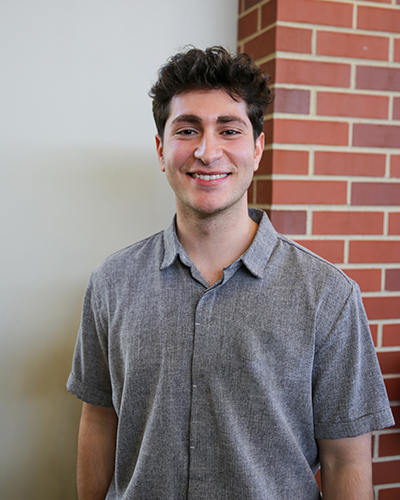 The new grad remembers the moment he received the news.
“That moment meant a lot personally, as it felt like a pause while letting the fullness of my journey sink in,” he said. “I had a quick flashback of my path I took, leaving my village in Egypt, crossing continents for high school in South Africa, and now building a life in Iowa. It made every difficult step worth it.”
Cornell President Jonathan Brand wrote a fellowship nomination letter for Elawady, saying, “I have known Mahmoud for his entire time at Cornell and think that he is truly exceptional as a student and a human being.”
The fellowship carries a stipend of $36,000, paid over three years. It will provide financial support, so Elawady can focus on his research and thrive in his Ph.D. program rather than just “survive it.” He’s looking forward to diving into his studies, which he became passionate about at Cornell. In fact, his research interest started early on through his participation in the Cornell Summer Research Institute as a first-year student working on a coding and bioinformatics project.
“Cornell is a community where you can rewire your thinking to challenge and rediscover yourself and find a path that matches a passion you built there,” he said. “Cornell helped me find the kind of scientist and person I want to become simply because I had people who believed in me and provided every kind of support they could.”
Elawady was also selected as an intern over two summers at the Mayo Clinic Center for Sleep Medicine in Rochester, Minnesota. It was through his classes, internships, and research experiences that he mapped out his plan to complete a Ph.D. in neuroscience.
“I am interested in studying the brain disorder subfield, specifically in Parkinson’s disease and dementia that often go beyond an individualistic diagnosis and can reshape families,” he said. “This human aspect is what drives me toward that field. At Mayo Clinic, my research focused on REM Sleep Behavior Disorder, a condition that can appear up to a decade before Parkinson’s symptoms emerge. That early window is where I believe the most important work lives. If we can understand what is happening in the brain during that period, we open the door to earlier interventions, better treatments, and eventually, I believe this genuinely, a cure.”
The McElroy Fellowship supports “deserving young people” who are pursuing advanced study in non-professional degree programs. Elawady is now armed with newfound backing from a team that believed in him and granted him financial support to chase his dreams.
As he looks to the future, he finds himself thinking of the past.
“I think a lot about the version of me that existed ten years ago as a kid in a small Egyptian village, wondering whether the world had room for someone like him,” Elawady said. “I want that kid to know that Iowa, of all places, made room. I hope one day, through my research, to contribute to improving human lives and help young kids, not just from Egypt but from all over, to find room in the research field that fits their dreams. I aspire to be for someone else what Iowa was for me, the unexpected place that says: yes, you belong here, and we believe in where you are going.”
The Trust benefactor, Ralph J. McElroy, was a pioneer broadcaster who founded the Black Hawk Broadcasting Company in 1947. He passed away in 1965. Paige Manning of the University of Dubuque also received the graduate fellowship.