
Back in October, the Nobel Prize in chemistry was awarded to three scientists for creating metal-organic frameworks. Now, Cornell scientists are building on that breakthrough and exploring what the compounds can do during the Cornell Summer Research Institute (CSRI).
“When the Nobel Prize was awarded, I was very interested,” said JJ White ’28. “I did a lot more looking into what a metal-organic framework was. I thought, ‘This is something I'd be interested in doing,’ and that's what prompted me to go to Professor Cindy Strong and ask her if it was something we could study here at Cornell.”
Watch their research CSRI research unfold in this video:
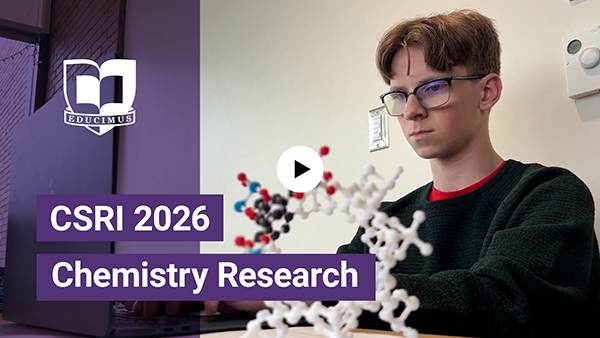
White is now creating several metal-organic frameworks in the lab and developing ways to incorporate them into Cornell’s chemistry curriculum.
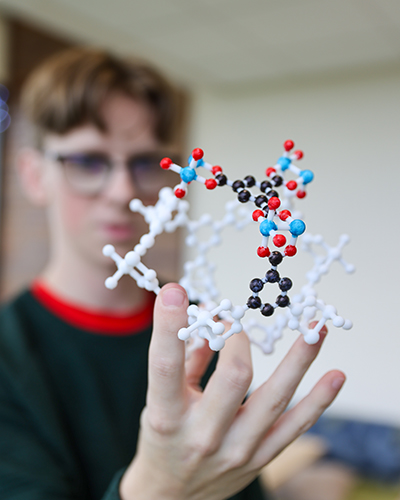
What are metal-organic frameworks?
Think of them as a 3D scaffold, where metal atoms act like joints and organic molecules act like beams, forming a structure with lots of open pockets that can trap gases or other molecules. Scientists believe the compounds could have many uses.
“The thing that really put the spotlight on metal-organic frameworks was their ability to adsorb gases,” said White, a native of Ely, Iowa, and a Cornell chemistry major. “Famously, one metal-organic framework (MOF-5) has a surface area, in one gram, of about a football field. So a gram would fit in the palm of your hand, and it has the surface area of a football field. Gases, especially CO2, could then be absorbed by all of that surface area, which could be very useful for managing climate change.”
The team says there are also uses related to hydrogen fuel storage, water purification, and chemical sensing. White and Strong are working together to create safer ways for future Cornell classes to create the compounds in the lab.
“The particular one that we’re working on can be used as a sensor for a food additive that’s used as an antioxidant,” said William Deskin Professor of Chemistry Cindy Strong. “In food oils, it’s added so that the oil doesn't get rancid. It’s a food-safe compound, but at higher levels it does have some hazards. So it’s important to know that concentration.”
The chemistry duo makes trips to the University of Iowa to use larger lab equipment, and they’re also finding ways to characterize the compounds using Cornell equipment, such as an infrared spectrometer and a UV‑Vis spectrophotometer.
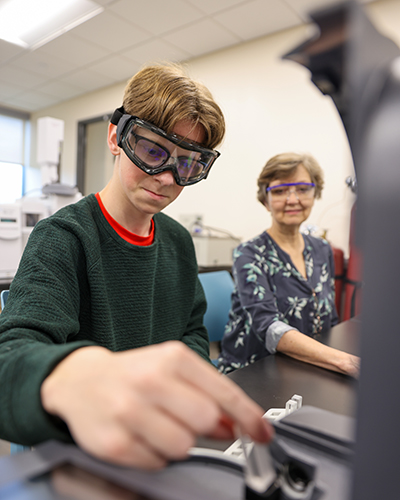
“We also have an atomic emission spectrometer that allows us to measure metal content very precisely,” Strong said. “Once we make, for example, a compound that has zinc in it, then we can break it back down and measure exactly how much zinc was incorporated into the compound. That kind of experiment fits very well into Advanced Analytical Chemistry.”
White says he’s enjoying teaming up with his professor and getting an opportunity to really focus on something he’s interested in for the full eight weeks of CSRI, especially when he gets to put his knowledge to work right away.
“I’m often doing literature reviews, and once I have read something, I go back into the lab and put those ideas into practice,” White said. “Say I read something new about how to characterize a compound, I will then go back into the lab and do that procedure.”
White and Strong are looking forward to completing their research and sharing their findings with future Cornell students. Plus, White knows these research skills will come in handy as he chases his dreams of becoming a chemistry professor.
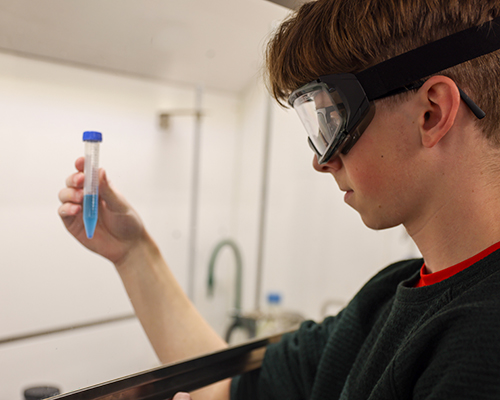
“I’m very thankful that I have this opportunity to do this research and stay at Cornell,” White said. “The other internships I was looking at over the summer were in Massachusetts, so being able to stay here in Iowa, especially since I’m from Iowa, is a big deal to me. Not having to worry about competing with people from all over the world for these limited research positions, especially since I don’t have research experience yet, is important. I'm really thankful for this chance to build my experience here.”
Strong is enjoying her time doing summer research with White, as she has with more than two dozen students since joining Cornell in 1989.
“Student/faculty research in chemistry has a history of about 65 continuous years at Cornell College, which is amazing. And it goes back to faculty like Bill Deskin, Addison Ault, and Truman Jordan, who regularly conducted summer research with students. There are a lot of alumni who maintain strong connections with Cornell due to those positive experiences.”