
One Cornell Summer Research Institute (CSRI) team is using its engineering, technology, theatre, and music skills to create a space designed especially for two campus musical ensembles.
The CSRI team, which includes rising junior Preston Lippe ’28, rising junior Avery Lozano ’28, and their mentor, Visiting Professor of Music Ben Laur, is working together for eight weeks to develop a plan to enhance the acoustics of Room 144 in Armstrong Hall. Their goal is to create a dedicated and optimized space for the Jazz and Pop/Contemporary ensembles.
“Having a more specialized space will allow for a more conducive atmosphere for practicing,” said Lippe, who plays in the Jazz Ensemble.
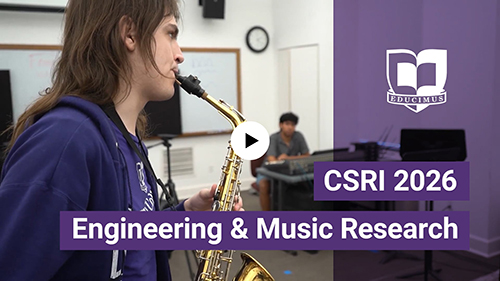
Watch their CSRI research unfold in this video:
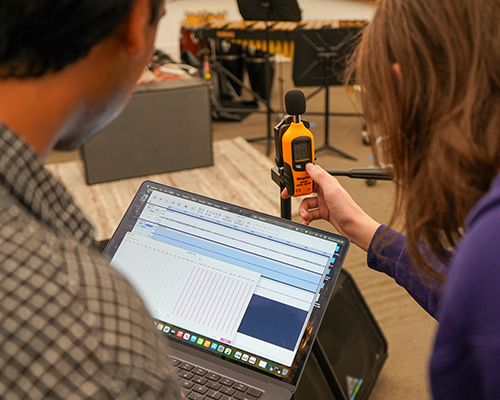
The team first set out to collect data on their space before deciding which types of acoustic treatment to use. They measured the room without the musical instruments inside. Then they used a test frequency playing over speakers and a sound pressure level meter to study the levels throughout the room.
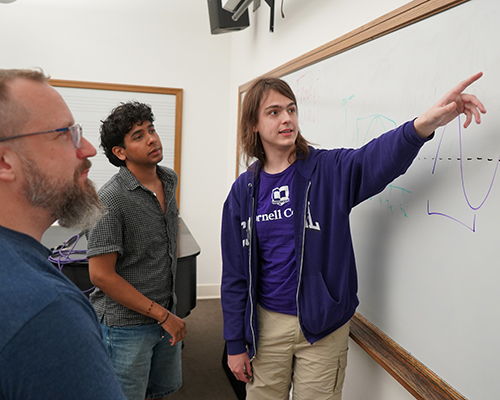
Lippe and Lozano also tested RT60, which stands for Reverberation Time. It measures how long it takes for a sound to fade by 60 decibels after the source stops.
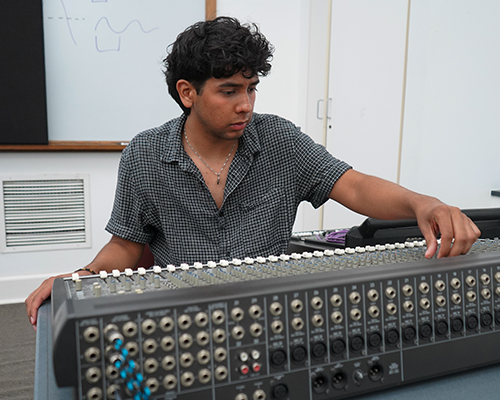
“We were able to come back after that testing and have a discussion about the high, middle, and low frequencies,” Laur said. “What is this room doing? Where does this room need help? Are there specific areas of the room that we might hypothesize need more acoustic treatment based on your testing?”
They’re now making plans for placing sound treatment resources to improve the levels throughout the room, and will continue testing to see if their plan is working.
“Acoustic treatment is more about using acoustic panels, foam, and large gobos to soak up, absorb, and then also diffuse some of the frequencies in the room, to bring down the sound pressure level and also the reverberation so that it’s a little quieter in the room,” Laur said.
The students are enjoying mapping out their own plans for solving this issue, and each day is a little different.
“If we’re doing a super testing-heavy day, we’ll meet in the morning and work on our methods, like what we’re doing and why we’re testing it a certain way,” Lozano said. “And then we’ll meet in the afternoon with Laur and run through all of our testing. And if we’re not doing that, it's either setting up or bringing in all of the instruments and speakers into the room, or making sure the room is ready for us to move on with further testing.”
Behind the music
Laur says this specific CSRI team is making this project a success. The students have a mix of interests that work well together.
“They both have their own unique backgrounds they are bringing to the project,” Laur said. “Preston has an engineering background, so when it was time to visualize everything in the room, he made a CAD (computer-aided design) model of the room. Avery has more of a sound production background. So when it came time to make the test frequencies that they were going to use to measure sound pressure level and reverberation, Avery was able to help do that using a piece of software.”
Lippe is an engineering major with minors in music and physics. He is planning to go to grad school for physics.
“CSRI is giving me an opportunity to look into, specifically, sound waves and also take into account a finished product—a highly specialized finished product—as opposed to something more general. I have really enjoyed getting to do cross-disciplinary work,” Lippe said.
Lozano is a double major in psychology and theatre, with a focus on sound design. He has been the sound designer and sound assistant for Cornell theatre productions and dreams of touring with artists to work their live sound for concerts. He says these skills could help if he lands a job in the recording industry.
“It’ll be helpful to know how to soundproof an area where there is no outside sound coming in, or mitigating frequencies to make sure people’s hearing isn’t impaired, but also that it is the crispest sound that I can have,” Lozano said.
For now, though, both Lozano and Lippe are excited about what this will mean for the ensembles that will use the room next year.
“Having a space where that is much more controllable will definitely make musicians more comfortable and excited to play,” Lippe said.