
The first round of 2026 Senior Art Shows will feature eight graduating studio art majors showcasing their year's creative journey from March 29 to April 8. These senior thesis exhibits will feature a diverse array of art forms, including painting, photography, fashion, and more.
An opening reception will be held from 2–4 p.m. on Sunday, March 29, in McWethy Hall’s Peter Paul Luce Gallery, Cole Library Gallery, and Hall-Perrine in the Thomas Commons, where the exhibitions will be featured. The shows are free and open to the public.
All Cornell senior studio art majors receive studio spaces and prepare exhibitions of entirely fresh bodies of work in the mediums of their choice. They propose their exhibitions before the department faculty, mount the exhibitions, and advertise and defend their shows in front of the art and art history professors.
A second round of Senior Art Shows will take place April 19–29. Here is how the student-artists describe their work in their own words:
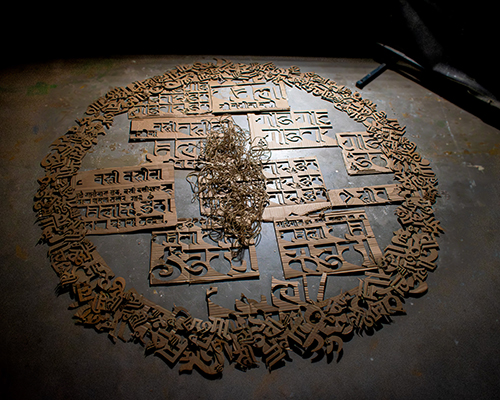
After crossing 11 time zones from Mount Vernon, Iowa, Smriti Neupane reaches home in Nepal. So far away, yet the stories that unfold there feel impossibly close. In September 2025, Nepal’s Gen-Z took to the streets. It began with social media videos exposing the gap between politicians’ children living in luxury and rural communities struggling for basics. On Sept. 8, students in school uniforms marched. But 22 people were shot, including the artist’s friend. The next day, millions filled the streets, in agony and grief over the police killings, from fourth graders to grandparents, and the government fell. What became clear in the aftermath was how money and power had orchestrated everything from who gets seen to who gets to dream.
Smriti's exhibition transforms that moment into an immersive experience with over 60 artworks. At its heart is a central question most of us recognize: how money shapes our lives, our choices, and our futures, often before we even get a say. Throughout the gallery, audiences walk among pieces that examine how wealth controls media, determines access, and decides whose children eat and whose children struggle. The work explores how a generation raised on social media became the conscience of a nation, demanding accountability from systems that failed them. The show features large-scale installations, including “Where Revolutions Begin,” constructed from cutout letters of a revolutionary song, woven with jute rope to honor the women who rise from grassroots levels to lead change. Paintings like “A Burning Heart Builds a Revolution” show how care and courage lie at the heart of protests.
But more than anything, this exhibition is a tribute to everyone who cares about each other. To the ones who show up, who refuse to look away, who hold space for grief and hope in the same breath. Together, these works ask what connects us across time zones and what we owe each other in the fight for a world where money and power don’t get the only vote.
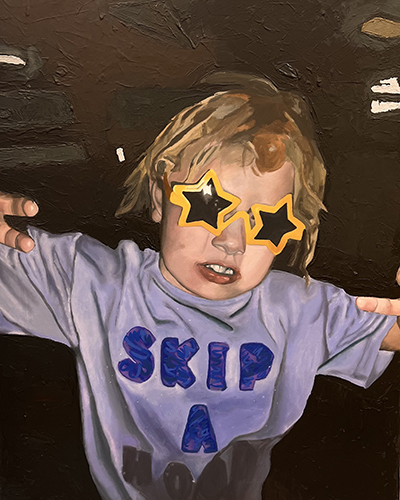
Schwab’s show, “In Every Moment,” reflects a childhood shaped by both tenderness and hardship. Growing up amid the challenges of divorce, abuse, and constant change, she experienced the confusion and emotional weight that often accompany a fractured home. Yet within those circumstances, she also discovered an enduring sense of faith. Looking back, she recognizes the steady presence of God guiding her through each moment—joyful, painful, and uncertain alike. This exhibition becomes a reflection of that journey, revealing how faith, resilience, and memory intertwine to shape her understanding of childhood and identity.
Through painting, the artist revisits cherished childhood photographs, transforming them into vivid visual narratives that balance innocence with complexity. Rather than simply recreating images, she uses vibrant color, expressive figures, and contrasting textures to capture the duality of her early life. Smooth transitions and luminous hues reflect the energy and playfulness of youth, while heavier textured layers beneath the surface represent emotions that were less visible at the time—anger, confusion, loneliness, and grief. By placing these textured elements in the background, she symbolizes experiences that were present yet largely unseen, even to herself, during those formative years.
Together, the works form a deeply personal story of reflection, healing, and faith. Moments reimagined through paint, inviting viewers to see childhood as both joyful and fragile. What may initially appear as simple memories of youth gradually reveal deeper emotional layers, encouraging viewers to look beyond the surface. Through this body of work, the artist honors the resilience of her younger self and celebrates the grace and strength that were given to her by Jesus, illuminating both the beauty and the struggle that shaped her journey.
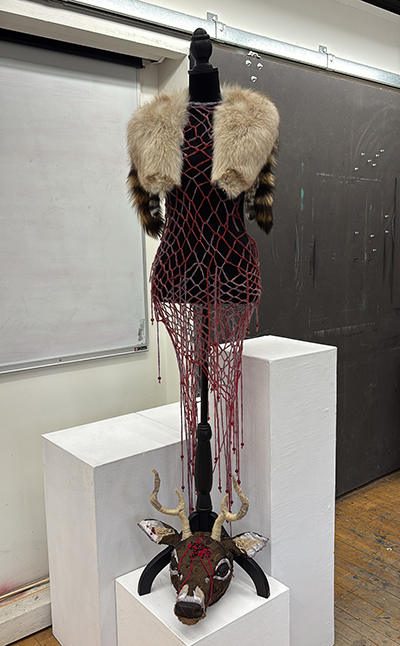
As a fashion collection, “Roadkillers” is a culmination of the artist’s thoughts and emotions around queer femme midwest culture shock–primarily, coming to midwest Iowa and being both disturbed and creatively intrigued by the constant roadkill on highways around campus, something that is a rarity in Kira Short’s home city of Los Angeles.
While photographing a series of these roadside corpses, the artist explores her growing self-identification with them, in tandem with the political climate of the U.S. growing more and more fraught. Short’s photographic documentation serves as a blueprint or vision board for “Roadkillers,” a collection of eight looks created for when the isolation and discomfort of being a queer woman become too hard to ignore.
The garments presented use motifs associated with the gore of car-mangled carcasses to reframe these aesthetics as a kind of armor, or metaphysical protection, for the artist herself and other women or queer people in her community. Even when reality may be scary or painful, fashion can be a transformative tool to practice resistance and liberating self-actualization.
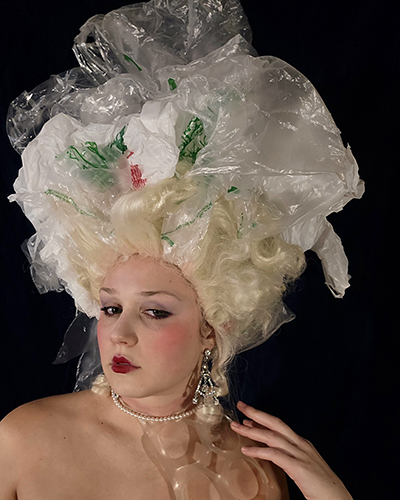
Isabella Strauss’ show, “Do You Kiss Your Mother with that Mouth,” explores the intersection of environmental destruction and the historical oppression of women. Growing up surrounded by nature documentaries and the ecosystems around her, she became aware at a young age of how quickly the planet was changing and how much of that change was caused by human greed. This awareness shaped her decision to study biology, not as a career focused on profit, but as a way to better understand and care for the world.
Alongside biology, Strauss studied art and art history, where she encountered a different kind of exploitation. In many historical European paintings, particularly in Italian art, women were often portrayed as passive subjects shaped by a patriarchal society that controlled their image and identity. Learning about these histories helped her recognize parallels between the ways both women and nature have been objectified, controlled, and exploited.
Strauss’ work grows from this intersection. Using unconventional materials and found objects, she creates female figures that act as contemporary interpretations of women from the past. Industrial materials such as plastic and metal reference the rise of industry and the systems of control and consumption that followed it. In contrast, natural materials and organic forms suggest a connection to the living world that existed before this industrial dominance. These figures exist between the natural and the industrial, representing both conflict and resilience. Through their presence, they become survivors of the forces that attempt to control them. By placing these materials and forms together, her work reflects on the shared histories of exploitation between women and nature while emphasizing their persistence and ability to endure.
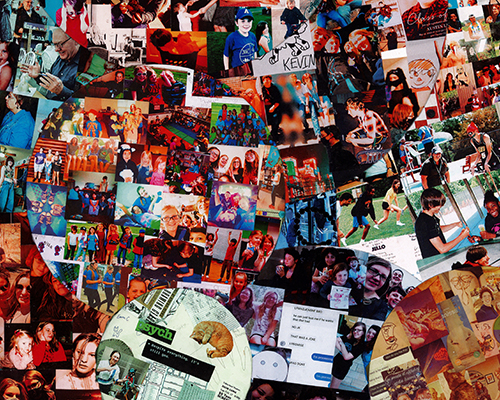
Janissa Weber’s show separates itself into two main pieces. The first is a demo for a point-and-click visual novel-style videogame that has been in development for the past seven years. Its characters and stories have taken much inspiration from “death game” type media such as the series “Saw” and “Danganronpa.” This game has remained a passion project for the artist, and will continue into further development after the exhibition has taken place.
The second major piece is a series of collages that were crafted to show the love and appreciation the artist has for the people she has met throughout her life. She hopes to give space for those people and memories through this work and the show in its entirety. All in all, the show exists as both a way for the artist to express herself and as a way to express her desire for others to see pieces of themselves in her work.
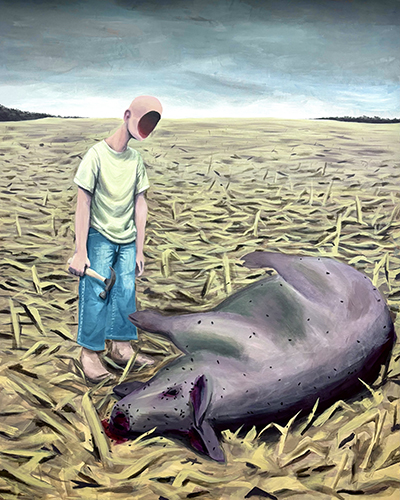
Harrisen Kargol’s show, “It’s Only a Dream,” is a surreal dramatization of his experience growing up in the Midwest. Focused on the state of the contemporary American Dream, his work attempts to reconcile with the choices he must make to achieve success. The mourning son is the primary character within this show, who represents the challenges Harrisen finds himself in as he comes into his own. The character’s face is often distorted, missing, or obscured as a way to convey a sense of apathy, guilt, or pain, something that the world keeps trying to push onto us.
*Panos Anastasiou will also present a show in Hall-Perrine.
*Jennifer Deeney will present a show in Cole Library.