
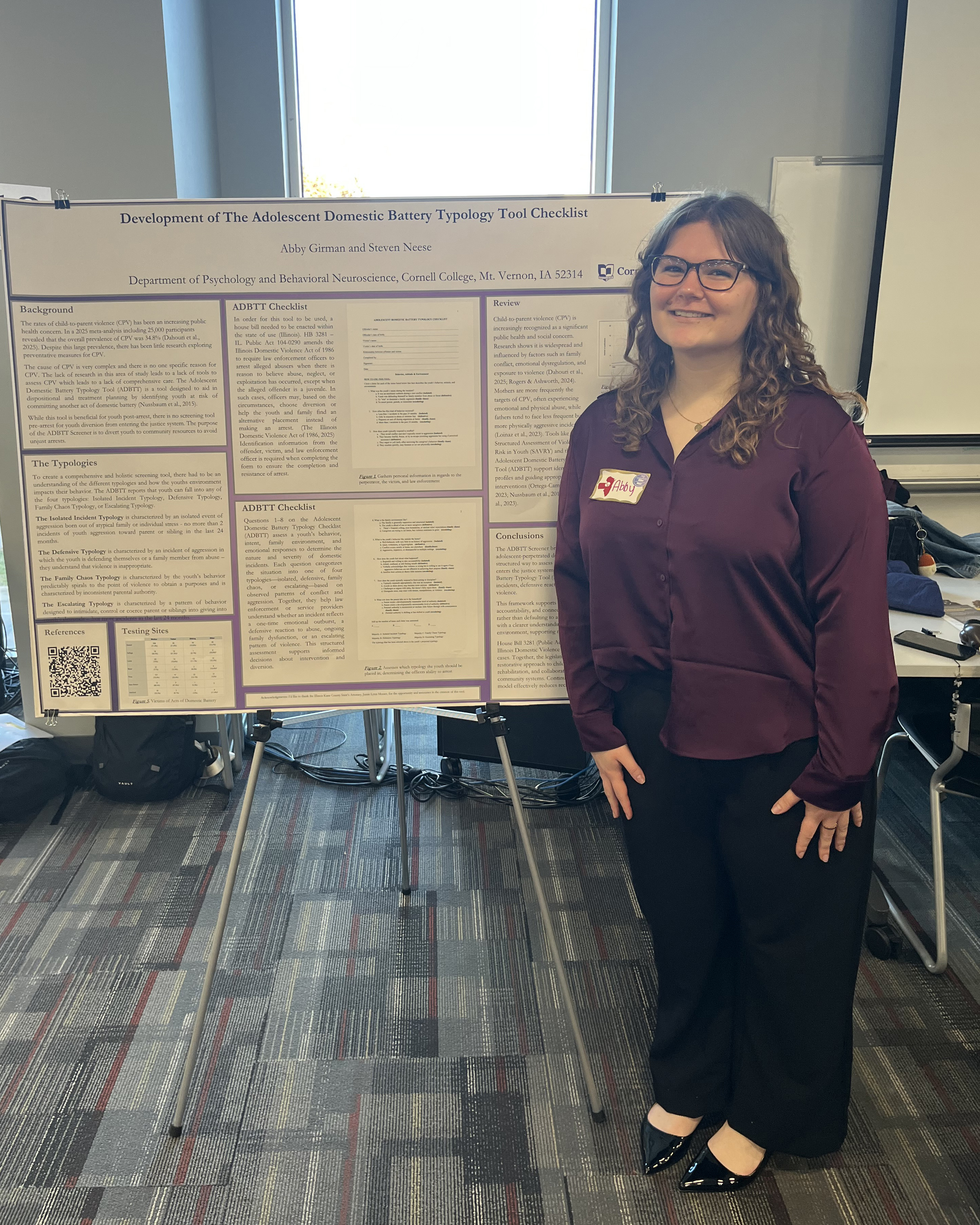
 Abby Girman ’26 is still months away from graduation, but the skills she’s been learning at Cornell are already changing the lives of adolescents and families in Illinois.
Last summer, she accepted an internship with Kane County (Illinois) State’s Attorney Jamie Mosser. Girman didn’t know what she was getting herself into, but Mosser knew Girman was majoring in psychology, with minors in sociology and gender studies.
“I was an intern for the Kane County Judicial Center, and she had me on a project that she’d been wanting to do for a while,” Girman said. “She gave me this 150-page manual to sift through and make a checklist for officers in the state of Illinois to fill out when they arrive on a scene involving juveniles.”
The project was to create a checklist to assist police officers called to houses for domestic violence incidents involving adolescent perpetrators. Illinois state law allows for police officers to use their best judgment on whether to arrest the adolescent or refer them to community services. The checklist is meant to give the officers guidance on when each option is appropriate. It’s a project that feels personal to Girman.
“If this tool were around when I was in high school, it would have helped my family locate resources. I was a kid that would have benefited from this,” Girman said.
To accomplish this, Girman found a way to combine a 150-page social worker’s training manual with the 30-page Adolescent Domestic Battery Typology Tool (ADBTT) used by social workers in the field. The ADBTT evaluates the juvenile’s motivation and potential for repeated behavior. The resulting product is a condensed, paper checklist that the police can fill out in the field to determine which outcome is best in each incident. Girman’s first draft was four pages long.
“One thing that was really hard for me was making sure it was inclusive,” Girman said. I originally had a section about risk factors, like has the child been physically, sexually, or emotionally abused? Do they face housing instability and food insecurity? Things like that.”
After receiving feedback from the local chief of police, Girman realized even four pages was too long to use in the field. She was going to have to make cuts on risk factors she’d hoped to include. It took her two months of intense, almost full-time work, but she got the form down to a one-page, multiple-choice checklist.
Officers on the scene ask the child in question about motivations, environmental factors, family life, and how many times a similar event has occurred. Based on the results, the police can identify when arresting the adolescent is the appropriate choice.
The form Girman created transitioned into a pilot program in her hometown of Elgin, Illinois. Then, Governor JB Pritzker signed off on the program, rolling it out to more locations.
“They're doing a wider pilot study beyond Elgin, but not fully statewide yet, and they're putting a review board together. I'm on the review board, and so are the creators of the Adolescent Domestic Battery Technology Tool.” Girman said.
The review board will look at each instance of the tool being used in the field, review whether it was used correctly, and make adjustments as needed. Girman was also responsible for creating the presentation used for training officers on how to use the tool.
The Cornell senior cites the block plan and having a lot of supportive professors as the keys to her success.
“I have a lot of good, supportive professors here. Steven Neese, Krista Robbins, and Tori Barnes-Brus. They're the best support system I could ask for,” Girman said.
Professor of Sociology Tori Barnes-Brus has known of Girman’s interest in improving the lives of children in the court system since they first met. Barnes-Brus believes Girman’s commitment to a just system and willingness to share her experiences with her classmates is a bonus.
“Through this internship, Abby was able to engage in a project that had real world implications, a real chance to improve the system,” Barnes-Brus said. “I love when students have these amazing experiences, applying what they learn to the real world, then bringing those real world experiences back to the classroom. It's really the beauty of our small liberal arts approach to education–theory and practice.”
After graduating in May, Girman will enroll in a master's in social work program at the University of Illinois, Chicago.
“These are real lives and real families that are feeling the same way that I felt when I was in high school, and that was the worst time in my life,” Girman said. “So now that I can change that for somebody else, like hello, who wouldn't want to do that?”