
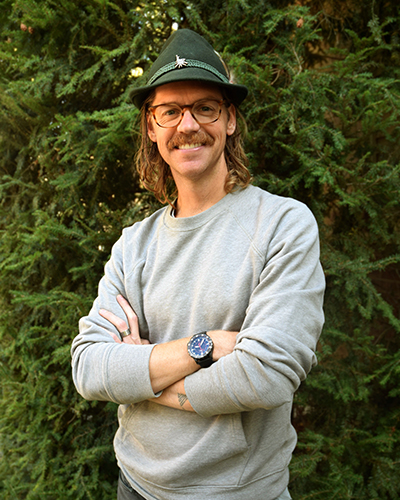
This story is written by Associate Professor of German Studies and History Tyler Carrington, reflecting on the Block 1 course, The Alps: Culture, Econ, Ecology.
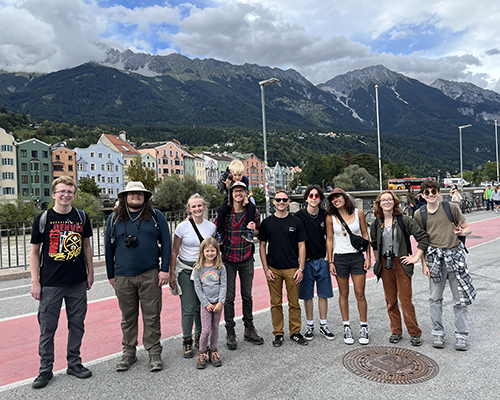
Last fall I took a group of Cornell students to the Alps for a German course investigating the cultures, ecologies, and economies of the German-speaking Alps. Over three weeks in Austria, Italy, and Switzerland, we hiked, yodeled, toured mountainside farms, learned how to make Swiss cheese, listened to marmots squeaking along trails, explored castles, went deep into a silver mine, and, if this isn’t already evident, lived the good life, Alpine style.
The good life. I think Americans often look to Europeans and wonder how they do it. Free education, good public transit, years (or so it seems) of parental leave, affordable health care—these can stand in stark contrast to life in the States, where we do get unlimited refills but not exactly some of the other things.
Why don’t we have this? Or rather, how do Europeans achieve this? I heard growing up that this all costs money and that the social democracies of Europe levy immense taxes on their citizens, who trade some measure of autonomy for a higher standard of living. Maybe.
But I had a eureka moment in the Alps with my students, specifically when we were meeting with the South Tyrolean Alpine Club, a non-profit association of alpine enthusiasts who, collectively, and in their spare time (for there are practically no paid or full-time employees), care for over 3,500 miles of mountain paths and offer hiking tours, youth programming, mountain rescue, and public environmental advocacy. The club has over 80,000 dues-paying members (dues make up 90% of their annual budget), which is a staggering 15% of the regional population. So one in every six South Tyroleans is in the Alpine Club.
German-speaking Europe is filled with clubs and voluntary associations: Rotarians and Lions, yes, but also singing, woodworking, sailing, sewing, automobiling clubs–basically everything under the sun. The old saying is that whenever three Germans get together, they form an association (a "Verein;” registered with the state, it’s an e.V., an “eingetragener Verein”). And perhaps that’s not far off (the law actually requires a minimum of seven).
 But while we might chuckle at the thought of the Association of German Rabbit Breeders (the “Bund Deutscher Kaninchenzüchter e.V.”), I think this is actually part of the secret to the good life Europeans undoubtedly live. Their world isn’t perfect, but neither do they leave so much for individuals to do themselves, and, critically, the guiding motivation is not profit. They have nice hiking trails because the members themselves spend their own time maintaining them. The point isn’t to charge others to enjoy them. The point is to have nice things for everyone to enjoy.
There are over half a million clubs in Germany alone, and I think they represent something worth emulating: together, as a community, we can make the good life for ourselves and others by focusing not on profit and ROI but by joining together to make and maintain accessible, common-good places to live.
So if you can’t make it to the Alps, consider joining a club. You might find–and begin building–something similar there.