
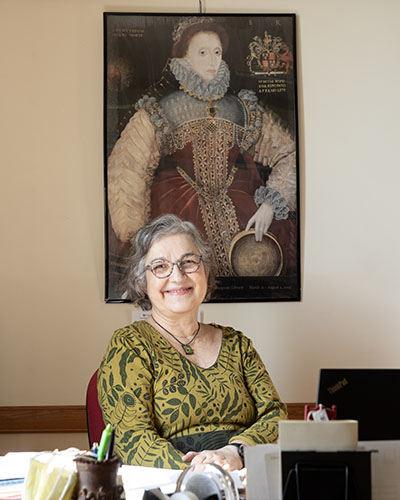
As a new university instructor in Bulgaria, Cornell College Professor of English Kirilka “Katy” Stavreva endured food shortages, lack of heating, and impoverishment during the country’s transition from communism. Once she realized her academic career was unsustainable there, she applied for U.S. graduate programs. In 1991 she arrived at the University of Iowa on a full scholarship, carrying two bags and $800. Ten years later she began teaching at Cornell, where she co-founded the Foxden Press and was honored as a Richard and Norma Small Distinguished Professor. Stavreva is the author of “Words Like Daggers: Violent Female Speech in Early Modern England,” a 2014 book challenging the myth of the silent, obedient woman of the era, and co-author of “The Merchant of Venice (Shakespeare in Performance)” (2023). She is married to historian Doug Baynton, with whom she has a grown daughter.
How were you affected by the fall of communism in Bulgaria?That first hungry winter (1989-90), I was living on political elation, coffee, and grilled cheese sandwiches from the faculty cafe at Sofia University, where I worked. We were rallying in the squares, but grocery stores were empty because inflation was going up while food prices remained regulated. Bulgaria had allegedly become a market economy overnight, yet most everyone was state-employed, and salaries were effectively shrinking as rent and the prices of available staples skyrocketed.
I was teaching at the country’s flagship university, but that winter I had to take on a second job at a newspaper, translating and developing a summary in English of Parliament news. The constitution was being amended to pave the way for the first democratic elections since World War II, the press was finally free, and people couldn’t get enough of the news because history was unfolding rapidly. We were learning active citizenship and political courage, for which we had few models.
The protests were a little dangerous, but because the university was right next to the Parliament, students and faculty were constant participants. In any case, the heat was off due to power shortages, so it was warmer and more exciting to be in the square. At some point the Prime Minister got worried about a breach of the Parliament building and mumbled that the tanks should be brought in; this was caught on camera, aired on TV, and triggered a student occupation strike of the university. Nobody knew if the police would break in, in spite of the nominal autonomy of Sofia University. We lived in hope and fear.
Free elections took place in the spring. Unbelievably for us—the winter-long protesters in the nation’s capital—the communists were voted back into power, albeit with a new name.
Why did you decide to leave Bulgaria?I would have needed a third job to survive. By that point, I had a well-developed identity as an academic and started writing on Renaissance poetry. But it was impossible to be an academic while working three jobs. A friend suggested that I could apply for Ph.D. programs in English in the U.S., where scholarships were available. In the pre-internet era, I took a shot in the dark.
In the meantime Bowling Green State University in Ohio launched a program in applied philosophy, designed to train the future political leaders of the new European democracies, and I was recruited for it. I was torn. I ended up applying for both English and applied philosophy Ph.D. programs. I got in, with offers of tuition fellowships and small research assistantships, but didn’t know it for weeks, because the letters (letters!) had arrived while I was at a conference in magical Dubrovnik, in then Yugoslavia.
Coming back I found out that the newspaper I had been working for was about to close. Its founder had published a discrediting article about backdoor Parliamentary negotiations and was pressured to disclose his source. He upheld his professional ethics and was forced to resign. That’s when I realized that political ruthlessness was not something I could stomach or navigate. I accepted the offer of the University of Iowa English Ph.D. program and arrived in Iowa in August of 1991 with $800 for insurance and two bags, mostly full of books.
What were your hopes or expectations for life in the U.S.?For a long time I really didn’t dare hope for anything. In Milton’s “Paradise Lost,” the archangel Raphael tells Adam to “dream not of other worlds”—a line that has always rankled me. But looking back at my path, it seems that I may have been wary of dreaming. So instead, I would start doing the things I deemed were “me.”
What was your path to citizenship?I came to the U.S. on a student visa; three years later I won the green card lottery. It was the first time that East Europeans could participate. I applied, along with several friends from Sofia University who were also enrolled in Ph.D. programs here—all high-achieving, unattached women in their 20s. I’m not sure how accidental the draw was, but we all “won.” There was confusing and copious paperwork to complete afterward, and I could not afford a lawyer. So the law school library came to the rescue, where I teased out the immigration code.
What things do you like best about living in the U.S.?My loving American family who has embraced cultural hybridity, my students who never fail to surprise and delight, and a network of friendships—from Eastern Iowa to the coasts—with people of kindness, talent, intellect, and courage. And yet, my closest scholarly allies right now are an energetic and diverse group of East-Central European Shakespeareans. Working with them from here has opened up a perspective that inhabiting a single culture restricts. Just like with professional life at Cornell, I’m an insider-outsider, which allows me to see things more clearly. I often talk about this duality, and how to embrace it while resisting feelings of alienation, with Cornell international students.