
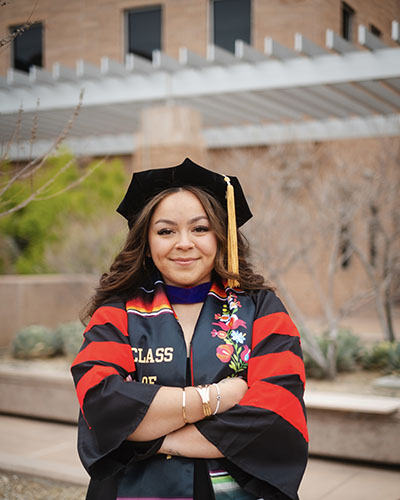
Alondra Granados ’20 was too young to remember crossing the U.S. border from Juarez, Mexico, with her teenage mother. Growing up in Albuquerque, New Mexico, as an undocumented immigrant, she quickly learned to navigate a world shaped by fear and uncertainty. Early on, Granados learned how to navigate challenges posed by Immigration and Customs Enforcement (ICE) operations. As she grew older, her commitment to social justice deepened, though she often worked behind the scenes to protect herself from the risk of deportation. Granados and her mother became U.S. citizens the day they drove to Iowa for her to attend Cornell College on a full scholarship. After graduating at the height of the COVID-19 pandemic with a degree in sociology and anthropology and a minor in civic engagement, Granados moved to Arizona to work as a paralegal. A year later, she returned home to attend the University of New Mexico School of Law. Today she works for a nonprofit immigration firm and another law firm.
What was your path to citizenship?
I came to the U.S. with my mom. I was young. My grandfather, a lawful permanent resident, eventually applied for a family petition for my mom and me. After several years, we were called in for an interview.
What was it like growing up undocumented?
My first experience with racial discrimination happened in kindergarten when I was called a derogatory name. I asked my mom what it meant, and she explained my immigration status, how to stay under the radar, and the importance of being cautious. From a young age, I knew I wanted to be involved in social justice work, but I kept my efforts behind the scenes for fear of being arrested or putting my status at risk. Growing up, I was constantly reminded to avoid speaking Spanish at school and to not draw attention to myself. Albuquerque was rife with ICE raids at the time, so it was also about learning to stay alert and knowing my rights if I or someone I knew was confronted by ICE.
Why did you become an attorney?
Becoming an attorney and doing social justice work was my goal from the start. Growing up in a community impacted by ICE raids and police interactions, especially in a low-income neighborhood, I became involved in advocacy early on. I helped organize Know Your Rights presentations, worked with clinics that assisted with work authorization and DACA applications, and became deeply familiar with the complexities of the immigration system. Having lived through these experiences, I felt a strong drive to help others in my community navigate the system and fight for their rights.
How do you use your law degree?
I work under contract with a nonprofit law firm in the unaccompanied minors division, and I’m also contracted with another law firm. My work primarily involves helping children and their families apply for Special Immigrant Juvenile Status. I handle most of the state court representation for these clients, which I find incredibly rewarding.
Tell me about your Cornell experience.
At Cornell, I was on the lacrosse team and participated in mock trial. I also worked a lot. While Mount Vernon was a bit isolated for me, since I had grown up in a city, I ultimately had a good experience. I met some wonderful people who remain friends to this day. Though I didn’t actively seek out opportunities, I found that people remembered the things I said, and when opportunities came up, they thought of me and let me know how to apply.
How has becoming a U.S. citizen changed you?
Becoming a U.S. citizen has made me more vocal, but it hasn’t changed who I am or what I want to do. I still feel deeply connected to my community and committed to social justice.
Is the American dream real?
I want to believe in the American dream, but I don’t. As an immigrant, you will always feel like an outsider to some people, especially those who don’t accept or understand your background. Despite all that, I continue to push forward, knowing that my journey is unique, and that I can still make a difference.
What advice do you have for immigrant students?
You don’t have to be the loudest person in the room to be the smartest. You know yourself best—you know how to study and how to navigate challenges in ways that others may not. Never underestimate your own journey, because your experience is different from those who had American-born parents with higher education. Trust your instincts and continue listening to yourself.