
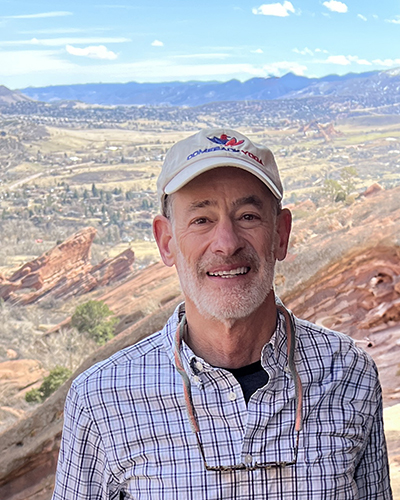
Ned Timbel ’76, a Denver native, enrolled at Western State College in Colorado because it was 30 miles from the gnarly ski slopes at Crested Butte, where a season pass cost only $80. After two years of going nowhere but downhill fast, he tore himself away from the mountains to visit small colleges on the prairie.
“Cornell was a standout,” he said.
A nature lover, Timbel majored in geology. After he handed in a term paper, his professor, Herb Hendriks ’40, told him, “You can barely write”—and then gave Timbel private tutoring until the young man got the hang of it. The teacher and student became lifelong friends.
“The most important thing Cornell taught me was how to learn,” Timbel said. “It’s one of the gifts of a liberal arts education.”
After earning his master’s at Miami University in Ohio, Timbel spent 35 years as an exploration geologist working as a consultant to oil companies and government agencies. He worked throughout the U.S. and in many countries, including Bangladesh, Myanmar, Pakistan, Namibia, Cuba, and Brazil.
“I loved my career,” he said. “I never knowingly made a recommendation that would harm the environment.”
His career was interrupted in the mid-90s when the World Bank dropped him as a consultant after he declined an assignment that would have taken him away from his family over Christmas.
That winter the pipes in the family’s cabin nearly froze when a propane tank ran out of fuel. In response, Timbel “figured out” how to use existing electronic circuitry to build a device that would monitor the temperature in the cabin and report trouble by telephone.
Eventually, he received two utility patents and eight trademarks, formed a company, refined the monitoring systems to serve various markets in 42 states, and then sold the company in 2001. It was a modest success. “I’m no Bill Gates,” Timbel said. He returned to geologic exploration, retiring in 2012.
Timbel and his wife, Margot, had been involved in yoga for many years. So, he pursued an interest in trauma-informed yoga, a highly specialized approach that can help people suffering from post-traumatic stress. “It can change lives,” Timbel said.
He became a certified yoga instructor. “I called the VA hospital in Denver and asked if they would like someone to teach yoga classes for people with PTSD.” He started with one class a week; soon he was teaching four as demand continued to grow.
When Margot, an oil industry executive, retired in 2014, she became a certified instructor. Then she and Timbel co-founded Comeback Yoga, a nonprofit organization that offers free classes to military personnel and their families. It teaches yoga, trains teachers in the methods of trauma-informed yoga, and gives scholarships to veterans to teach yoga.
They are both now directors emeritus of Comeback Yoga, which has three employees. In 2024, the organization paid 54 teachers to lead more than 20,000 hours of free student instruction in Colorado hospitals, clinics, military bases, and prisons, as well as online worldwide.
Dan Kellams ’58 has written two books set in his hometown of Marion, Iowa. His career spanned nearly 50 years in public relations in New York City, where he worked as a corporate and agency executive and, later, as a freelance writer and editor.