
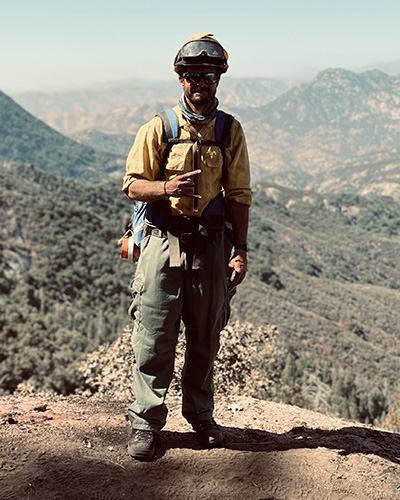
KJ Passaro ’14 spends his days in the rainforests and rugged terrain of Haleakalā National Park in Maui, Hawaii, leading a wildlife management team focused on protecting endangered species and preserving the park’s natural ecosystem.
“Maui is one of the most exciting places to do conservation,” said Passaro. “It’s at the forefront of endangered species management in the United States.”
It’s a path—although an unexpected one—he started exploring when he was a student at Cornell.
“I didn’t have any big goals as a kid,” Passaro said. “I ended up at Cornell, which was wonderful because it diverted my life in this new direction.”
Passaro took environmental studies courses and developed an individualized major called geoscience. Now he leads a team of 10 who monitor and manage populations like the Hawaiian goose, the nene, and the Hawaiian petrel, or 'ua'u, in the 33,000-acre park. The Cornell grad from Colorado is also prepared for fighting wildfires, as he did during the summer of 2024.
“Luckily, the fire stopped right at the fenceline,” Passaro said. “Because it’s so dry and there’s so much change to the climate, it just makes Hawaii a lot hotter and more fire-prone than it used to be. Getting called out for the fire was a wonderful feeling because I was able to use my training to help my park.”
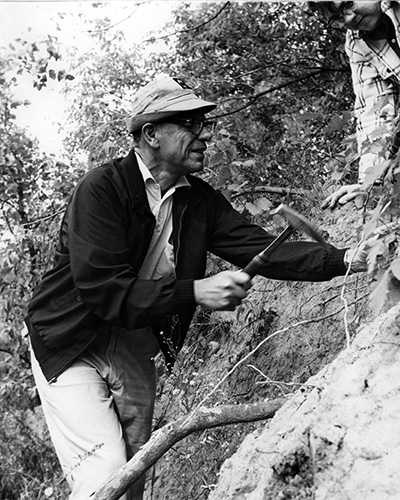
Passaro is one of the hundreds of graduates in environmental studies since Cornell initiated the major 50 years ago, in 1975. The program, which is believed to be the first of its kind among the Associated Colleges of the Midwest and one of the earliest college programs in the U.S., all started with Geology Professor Emeritus Herb Hendriks ’40. He became concerned about the sustainability of natural resources and petitioned for an environmental studies course. Students enrolled in that course, Environmental Systems, in the 1960s. His efforts to create a full major were rebuffed by the faculty for years, but eventually the full program was established. Under Hendriks’ oversight, students could individualize their majors based on their interests.
Today, the Department of Earth and Environment houses Cornell’s majors related to environmental studies: environmental science and sustainability, environmental justice and sustainability, and geology. Each major focuses on a different aspect of environmental studies, and students can major in a social sciences and humanities-based curriculum, or focus more on natural sciences. The program’s chair, William Harmon Norton Professor of Geology Rhawn Denniston, calls Hendriks a visionary.
“The environment comprises perhaps the most important set of issues we face as a global community,” said Denniston, who has taught at Cornell for 25 years. “Herb saw the writing on the wall a long time before many other people did. In the early 70s, there was a lot of talk about the environment, but to put this into an academic curriculum and recognize that students needed formal training—that’s real foresight.”
Dale Buxman ’78 was one of the first students to graduate with an environmental studies major, which, for him, included some political science courses. He put his degree to use throughout his career in agriculture. He’s retired now, but says his courses supported him in leading his company’s environmental and regulatory services.
“The poli-sci classes ended up being more helpful to me than I ever thought they would be when I took on the environmental and regulatory side,” Buxman said. “Government regulations are not easy to read. And I kept going back to my Cornell days, going ‘Okay, sort out what’s important and what’s not.’”
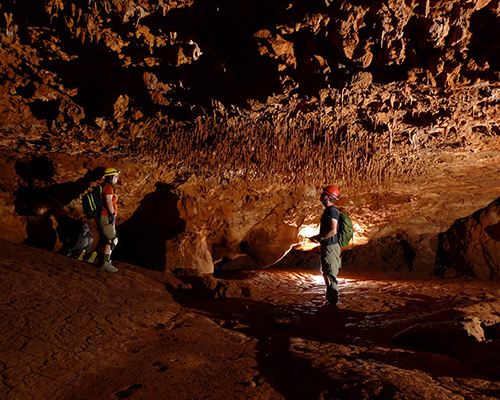
Over the years, the program has also supported a lot of student-faculty research. Passaro says Denniston and other scientists at Cornell helped him find his passion for the environment and made him feel at home.
“Cornell and the environmental studies program did a really good job getting us out of the school into a lot of local parks,” Passaro said. “There were a bunch of cool spots in the U.S. that Rhawn and the other professors took us to do fieldwork. I had the great experience of going to the Bahamas with Ben Greenstein for a wonderful month-long course with a research station there. And I traveled across the country to go to New Mexico and do research for Rhawn.”
While a lot has changed with the environment in the 50 years of Cornell’s environmental studies program, Passaro says those in the conservation field are already thinking about the next 50 to 100 years.
“We’re in this period where the climate is so relevant to every other part of industry and every other part of the marketplace,” Passaro said. “Whether it’s protection from fires and storms to expanding the need for people to have clean drinking water, the overarching theme is—it’s just inexorable. There’s going to be a massive need for people to work in conservation and the environment.”