

After three years of travel and research, Cornell College Assistant Professor of Classics Chris Hoklotubbe released his second book, “Reading the Bible on Turtle Island,” on Nov. 18. Hoklotubbe (Choctaw Nation of Oklahoma), who wrote the book alongside Danny Zacharias (Cree-Anishinaabe/Métis), explores the Bible from an Indigenous perspective.
The book is one of the first to focus on Native North American interpretations of the Bible, including tribes in both Canada and the U.S. The scholars included “Turtle Island” in the title, a term used by many Indigenous peoples to refer to North America.
“Our book was written for anyone interested in what difference it might make to interpret the Bible alongside the cultures, histories, ceremonies, stories, and wisdom of Native North American people,” Hoklotubbe said. “This book is a celebration and introduction to the life-giving, inspiring, and sometimes challenging contributions Indigenous scholars, ministers, and leaders have made in biblical interpretation.”
The research for this book began with a $30,000 grant from the Louisville Institute. The funds supported travel to Canada and throughout the U.S. to spend time with Indigenous authors, ministers, medicine men, and leaders, to understand how their Indigenous heritage impacts how they read and understand the Bible. Hoklotubbe said he wanted the book to reflect and celebrate the brilliant voice of Indigenous Christians who have generated insightful readings of the Bible.
“We wanted to be on the land of our friends, to perspire in sweat lodges, to drum—sometimes off beat—in circles, laugh deeply, listen to stories, worship in rural Indigenous churches, set up tipis, work on an Indigenous farm, dance, smudge ourselves with sweetgrass, and soak in the goodness of Indigenous life on Turtle Island—to marinate in all of this. We wanted all this so that our writing would reflect the diverse lifeways, principles, stories, and wisdom of Indigenous followers of Christ on Turtle Island.”
Hoklotubbe and Zacharias explore how Indigenous perspectives offer meaningful contributions to Christian theology. Their work invites readers to expand their understanding of biblical texts by engaging with interpretations that differ from conventional readings. For instance, Genesis is often interpreted in Western traditions as placing humans at the center of creation with authority over the land. Hoklotubbe and Zacharias offer alternative readings that challenge this view and invite deeper reflection.
“Many Indigenous creation stories remind us that we are the last and humblest of the created order. Frankly, we come across as quite needy, pathetic even in these stories,” Hoklotubbe said. “The rest of creation can do quite fine without us. But it is we who are dependent on everything else for our survival. When we turn to Genesis in our book, we argue that Genesis 2:15, where Creator commissions the first man to ‘till and keep’ the land (New Revised Standard Version), can reasonably be rendered ‘serve and conform oneself to’ the land. The former translation tends to objectify the concept of land as something humans form a transactional or work relationship with. Our translation of the Hebrew invites readers to imagine what reciprocal relationships with the land might look like.”
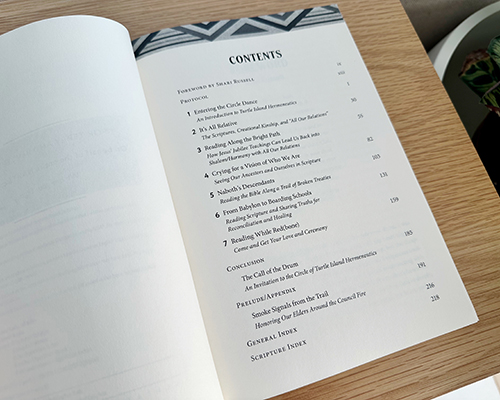
From the Indigenous Christ-followers to those interested in reading the Bible through a new lens, Hoklotubbe hopes this book’s effect is different for each reader.
“Our book invites readers to join the dance of Indigenous interpretation. I hope that they gain a greater appreciation for their interconnectedness with the myriad of relations around them, including the plants and animals. I also hope that Indigenous followers of Christ are encouraged to imagine how their own Indigenous heritage can enrich their theological understanding of Creator and their vision for how to walk the good red road or bright path of Jesus of Nazareth in restoring and maintaining harmony among all our relations,” Hoklotubbe said.
He anticipates that this book will spark more words, more conversations, and more understanding. Hoklotubbe plans on incorporating a chapter from the book into his Cornell College course, Native American Religions. The book is available for purchase on Amazon, and you can read a free excerpt at InterVarsity Press.
About the author:
Chris Hoklotubbe, originally from southern California, is an assistant professor of classics at Cornell College in Mount Vernon, Iowa. His first book, Civilized Piety (Baylor University Press, 2017), brings together his research interests in early Christianity, Greco-Roman archaeology, ancient philosophy, and critical theory. Hoklotubbe is also the director of graduate studies with NAAITS: An Indigenous Learning Community. The organization, in collaboration with Bexley Seabury Seminary, is celebrating as the recipient of a $10 million grant from Lilly Endowment Inc. The funding will help establish an Indigenous Theological Circle to strengthen access to Indigenous theological education and support Indigenous congregations across North America.