
After unknowingly holding a Mississippian Native American funerary statue in its collection for 125 years, Cornell College has returned it to its rightful owners.
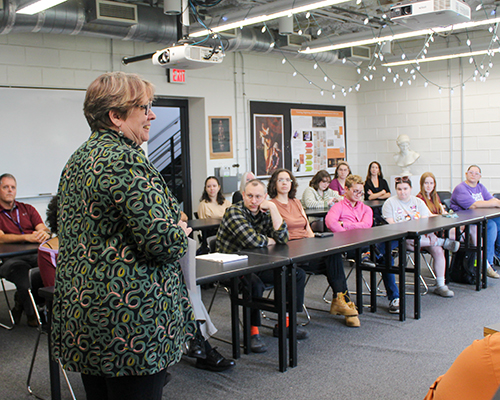
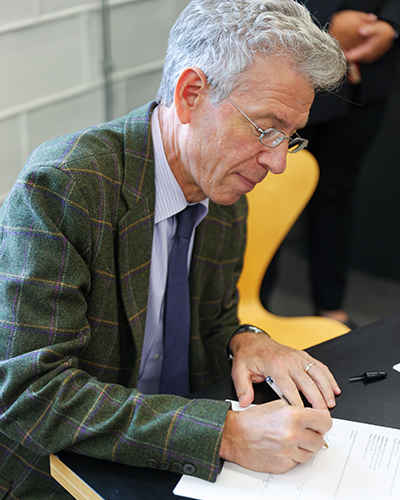
Faculty, staff, and students gathered for a ceremony on Sept. 30 in McWethy Hall, where President Jonathan Brand signed a document to legally transfer ownership of the statue to the Muscogee (Creek) Nation.
“This is a very special moment for our people,” said Muscogee (Creek) Nation Tribal Historic Preservation Officer Savannah Waters, who was one of three representatives who traveled to Cornell to attend the event. “Thank you for creating this moment. Thank you for letting us come get this and take it back home where it’s supposed to be.”
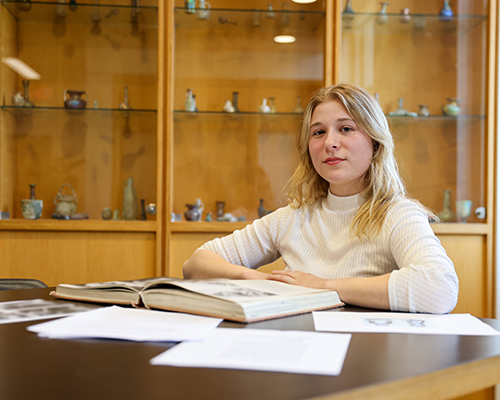
The origin of the 21-inch-tall and 56.5-pound statue was discovered in the spring of 2025 through research by Natalie Zenk ’25, who chose to examine the piece for her archaeology and art history senior thesis project. All she knew when she started was that the statue was donated to a Cornell archaeology and geology professor in 1900 by A.J. Powers, who purchased the statue in 1896. The work, with little documentation of its history, has been in the college collection since then.
Zenk started making progress when she found a photo of the statue in a book written in the 1970s and then again in a research paper published by a Cornell student in the 1950s, who identified that the statue came from Georgia. She then contacted Georgia’s state archaeologist, continuing to trace the origins of the statue linked to the Mississippian culture—an ancient Native American society that thrived across the southeastern U.S., and whose culture is believed to have developed in the Mississippi River and its surrounding regions.
“It felt like I was solving a mystery, and I was getting to delve into figuring out where this came from and the history of it,” said Zenk, who now works as an archaeologist at Prairie Archaeology and Research in Illinois. “In general, a lot of Mississippian statues don’t have a whole lot of research out there. So, knowing that my research is going to make a dent and actually be really important is quite exciting for me.”
Cornell’s collection was reviewed in 1994 for objects that fell under NAGPRA (The Native American Graves Protection and Repatriation Act of 1990), but it was incorrectly determined that the statue was not eligible. When Zenk reexamined the piece, she learned that it had been removed from a burial site in Georgia. She teamed up with Professor of Art History Christina Penn-Goetsch to get the return process started as soon as they understood the statue’s history.
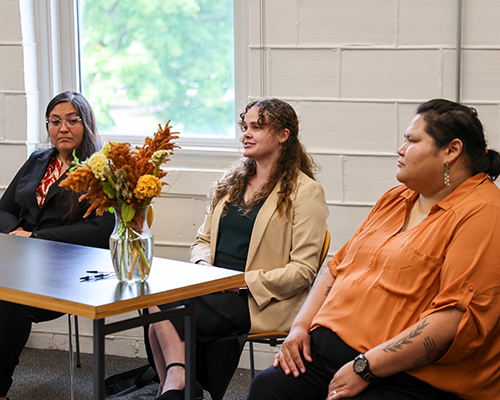
Muscogee (Creek) representatives shared at the ceremony that archaeologists excavated burial sites in the 20s, 30s, and 40s, and items from ancestral burial sites, or mounds, went around the world, including the one that landed at Cornell. Secretary of Culture and Humanities for the Muscogee (Creek) Nation RaeLynn Butler said this object was originally buried with their ancestors.
“I’m thankful for you all, being here today, allowing this opportunity to come and help us make something that happened in the past—that’s none of our faults—make it right,” Butler said during the ceremony. “No one’s grave deserves to be desecrated like that. And our goal is to make sure that everything goes back to rest the way that it should be. We don’t want our ancestors on shelves anymore.”
The Muscogee (Creek) Nation representatives are working with hundreds of institutions to gather items and remains from ancestral burial grounds. They say everything will eventually get reburied as they were intended near the Etowah Mounds State Historic Site in Bartow County, Georgia. Butler says institutions, like Cornell, that willingly return items mean a lot to them.
“It’s a way to help our people heal, a way to learn about our history, to honor our heritage,” Butler said. “Our people have had to overcome so much, and most of our lives have just been able to survive,” Butler said. “As we can reclaim these items and bring them back, it helps us reconnect to our homeland, but also to try to have a role and help fix what happened in the past. You know, we had no say in those excavations. We didn't even want to leave that land, you know. And so for all of these injustices to happen for hundreds of generations, and today, we all can be part of making that wrong, right. That’s what motivates me to continue this type of work.”
*Out of respect to a request from the Muscogee (Creek) Nation, Cornell is not using photos of the statue.
This story received media coverage on Iowa Public Radio on Oct. 2, "A student's research project at Cornell College led to the return of a 1,000-year-old Mississippian statue," and on Oct. 14, "The long, slow process of repatriation of Indigenous cultural items continues." It was also in the Corridor Business Journal on Oct. 16, "Cornell College returns funerary statue to Muscogee (Creek) Nation."