
Cornell College is collaborating with five other institutions on a $1.1 million National Science Foundation grant to study monsoon rainfall patterns across Asia, Indonesia, and Australia—important research for protecting freshwater resources for nearly 40% of the world’s population living in the region.
For decades, scientists have individually studied geological and biological records around the Eastern Hemisphere tropics to reconstruct past changes in monsoon rainfall. These records, which primarily include stalagmites, corals, lake sediments, and tree rings, provide physical or chemical signals that track how and when monsoon rains changed over the past decades and centuries. This new grant provides the opportunity to integrate all of these previous studies into a single coherent picture and target new areas for data collection. The goal is to develop a more comprehensive understanding of where, when, and why monsoon rainfall patterns have shifted—from Australia to Asia—and how they might change in the future.
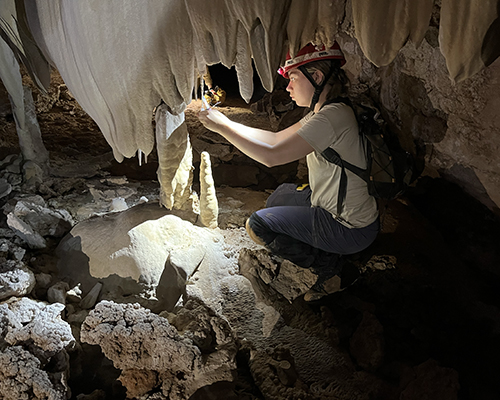
“Over the last ten years, my colleagues and I have done lots of research,” said co-principal investigator and Cornell College’s William Harmon Norton Professor of Geology Rhawn Denniston. “After staring at individual pieces of the puzzle, the full picture is finally coming into focus, thanks in large part to my colleague, Dr. Caroline Ummenhofer at the Woods Hole Oceanographic Institution, and Woods Hole/MIT doctoral student, Shawn Wang. We’re beginning to see the outlines of this big, interesting, cohesive story—not just in terms of what’s happening in northern Australia individually, but in Indonesia, southern Asia, and across the whole region.”
The research team aims to understand the mechanisms driving changes in monsoon rainfall patterns over the last 1,000 years, from medieval times before human-driven climate change, up to the present day.
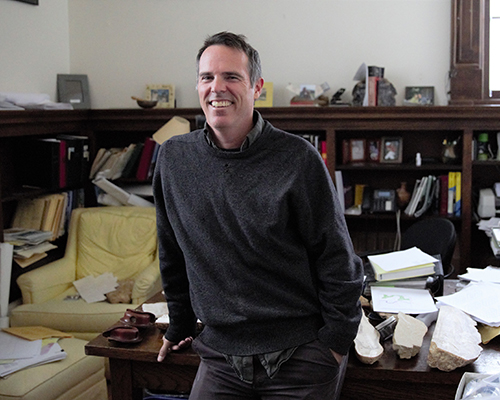
“Looking at any site by itself gives you only a small piece of a much larger puzzle,” Denniston said. “About 10 years ago, we began to see that there was something really exciting there, but we didn’t have enough pieces to make sense of it all. By integrating our work with that of many other scientists, we are beginning to see patterns developing. It’s recognizing these big patterns and seeing how cohesive the story is—where larger regions are responding similarly—that’s been the big breakthrough. Namely, that rainfall patterns across the tropical regions from Australia to Asia are changing more or less together but on pretty slow time scales—a few decades or more.”
Once researchers have assembled and integrated the data from all of the natural rainfall records, they’ll link everything together using climate models—with the hope of improving the ability to make predictions on decadal scales for the Austral-Asian monsoon.
“The more we understand the climate system, the better armed we are to deal with climate change,” Denniston said. “But sometimes modern climate change masks some of the underlying natural variability. Looking back at previous centuries through these natural records, we can get a better sense of how things worked before the rise of greenhouse gases or aerosols in the atmosphere. This has the potential to inform us about how climates may change in the near future—that’s very exciting to me. And so is developing this network of scientists who are bringing together our own perspectives and expertise to address this very important goal. It’s something I’m looking forward to.”
Denniston says he’s thrilled that Cornell students will play a big part in this three-year research grant, which begins in September.
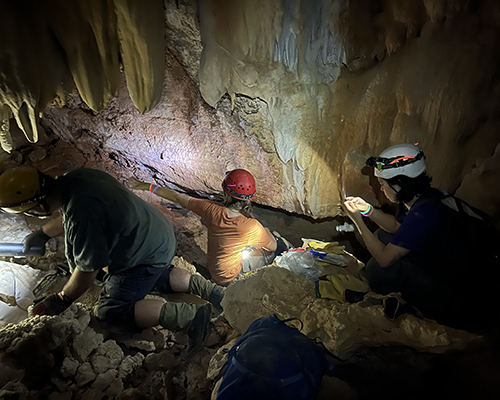
“My students are going to be working with top-tier scientists and their students from New York, California, Massachusetts, New Mexico, and Iowa. It'll be a great experience for them on many levels. They’ll get a chance to develop their own data and then to contribute it—present it—to the group, ” Denniston said.
Denniston’s research over the past two decades has focused on analyzing stalagmites in Australia and Nepal to reconstruct past changes in monsoon rainfall. He will use Cornell’s portion of the research grant, $216,994, to take students with him to new cave locations in Australia to collect additional samples, to work with them to perform chemical analyses in laboratories at Iowa State University and the University of New Mexico, and to make sense of their results as part of honors theses in geology or environmental science. Cornell students will also work on climate modeling at the Woods Hole Oceanographic Institution in Massachusetts, a collaborator on this grant. The other four institutions are Iowa State, Occidental College in California, the University at Albany in New York, and the University of New Mexico.