
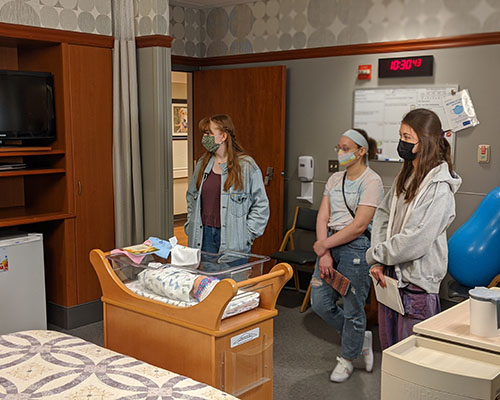
In response to a growing demand for careers in public health, Cornell College is rolling out a new major in community and public health (CPH) designed for the next generation of change makers. The major, available this fall, serves students interested in social sciences, medicine, or a mix of both.
“Building on Cornell’s roots as a liberal arts college, the new CPH major provides an intentional and interdisciplinary health-related career path, which contributes to our already robust pre-professional health majors,” said Professor of Sociology Tori Barnes-Brus.
According to the U.S. Bureau of Labor & Statistics, healthcare occupations will grow much faster than other job sectors from 2024–2034, with an average of 1.9 million openings per year. Public health focuses on evidence-based data to minimize health hazards, reduce health disparities, and support health and wellness for all communities. It includes professions in government, business, and nonprofit sectors, with roles such as social workers, educators, researchers, and policymakers, among others.
Senior Oriana McKanan ‘26 said she chose the CPH major because she wants to help people be the best version of themselves.
“Public health is so focused on looking at health holistically and at a community level, rather than an individual one, which allows us to see the root causes for health issues,” she said. “To me, that is a much more effective method of healthcare. Rather than fixing problems at an individual level, which both puts blame on the individual and allows the same issues to come up over and over again, public health prevents them from happening in the first place.”
Barnes-Brus, who will be the primary academic advisor for this major, spent a year collaborating with many departments on campus, including statistics, kinesiology, political science, psychology, and biology. She also spent a lot of time talking with students, like McKanan.
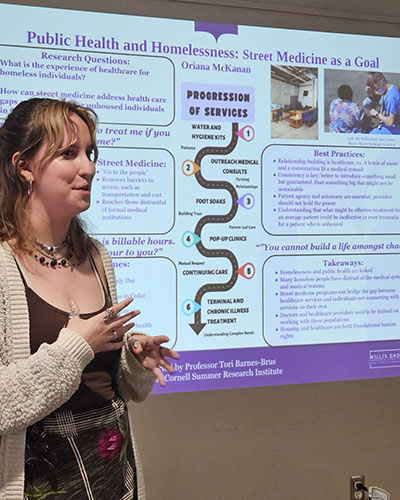
“I worked closely with Tori Barnes-Brus to think about how this major might look from the student perspective of things,” McKanan said. “I came to her with a desire to pursue this field of study, but with uncertainty of how to go about it, so I'm so excited that this will be an option for future students straight off the bat. I think, especially in a post-COVID world, the importance of public health has only increased, and I think this major will definitely spark people's passion and interest.”
Barnes-Brus also consulted the governing board for undergraduate public health degrees, the Council on Education for Public Health, as well as reaching out to alums who are currently working and teaching in the field during the development of this major.
The resulting major seamlessly integrates a broad spectrum of perspectives while providing students with a solid foundation to prepare them for their chosen career. There are eight core classes, including Fundamentals of Community and Public Health, Statistical Methods, and Epidemiology or Biostatistics, as well as several electives that can be chosen from a variety of courses. It also includes a research methods course, an internship or practicum, and a capstone project. This provides students a strong, intentional foundation as well as the flexibility to focus on their particular areas of interest or pursue a second major.
“Our capstone is geared toward reflecting on what students havedone and where they each want to go,” Barnes-Brus said. “It’s looking back, looking forward, and really figuring out what project will help each individual student position themselves for the job market, using their own academic experience to inform that.”
Students interested in community and public health as a major will also find existing off-campus courses, Second Year Seminars, and Cornell Summer Research Institute projects to dig deeper into their interests and build the groundwork for their future. Cornell’s Dimensions Program for Health Professions will also be available to students who declare this major.
Students interested in learning more about this major or any of the related courses should contact Professor of Sociology Tori Barnes-Brus.