
 It’s been almost 300 years since Eliza Haywood was alive and writing, but three Cornell Summer Research Institute (CSRI) students are gaining new insight into the evolution of her writing throughout her career.
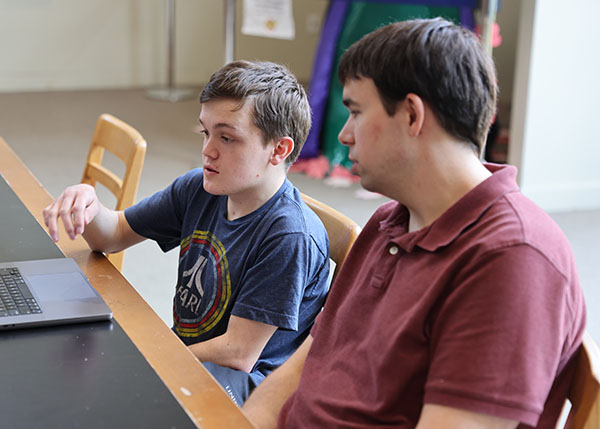
Rising sophomore Adelaide Ries ’28 and rising juniors Joe Wald ’27 and Noah Christenson ’27 are working with Associate Professor of English and Creative Writing Katie Sagal and Assistant Professor of Statistics Tyler George to combine conventional literary analysis and digital analysis tools for their summer research project.
“Her career is kind of split into two parts,” says Ries. “In the first part, she was writing a lot of scandalous, risqué literature that featured a lot of love triangles, affairs, and scandals. In the second part of her career, it was much more tame and conservative and more in line with gender expectations at the time.”
Many have written about Eliza Haywood's work, and the CSRI team used that to their advantage. In the late 1700s she was often criticized by conservatives. By the mid-to-late 1900s, however, she became the topic of serious literary scholarship. Within the past 40 years, there has been a particular increase in people studying her work as part of the history of 18th century literature. This provides the students with many opportunities to look for patterns.
“This is important for our field because it allows us to take advantage of new developments and technology to further nuance our understanding of literature,” Sagal says.
Watch this CSRI research unfold in this video: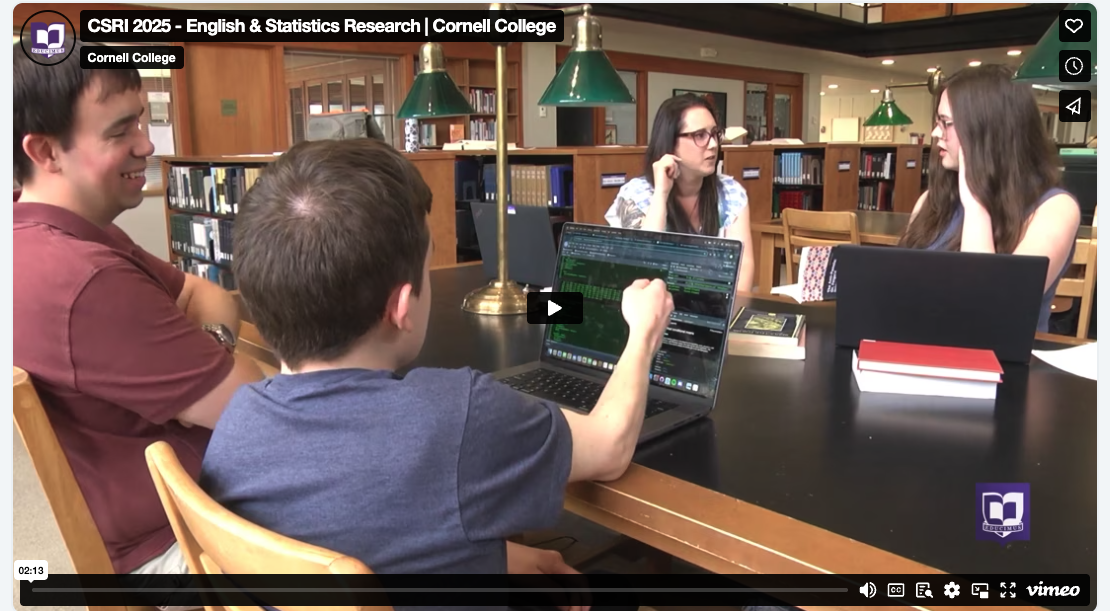
Marrying the traditional with the modern
The analysis of Haywood’s writing happens through two processes. In one process, the researchers must perform literary analysis and look for things like character development and themes, while also examining certain schools of thinking, such as feminist theory.
The second process is applying sentiment analysis using digital tools. In this case, sentiment analysis is what turns the written language into physical numbers. Sentiment analysis uses dictionaries that assign positive and negative values to words based on the emotional impact of the words. This allows researchers to turn language into numbers.
“We are reading about six books from the first part of her career and then three books from the second part of her career,” Ries says. “As we’re reading, we’re taking a lot of really thorough notes about different topics and themes that reoccur in her books. Things like love and marriage, sex, and gender.”
After identifying themes and patterns within Haywood’s works, the team compares them with the results of digital analysis, creating graphs and charts to help make the data more accessible to the general public.
“We have text analysis tools that allow us to split up works into sentences or even individual words just by clicking a button and telling the machine what to do,” Wald says. “Then we take what I’ve learned from crunching the numbers and what they’ve learned from reading the text, and we compare and contrast what we’re seeing so we can get that multifaceted analysis of her text.”
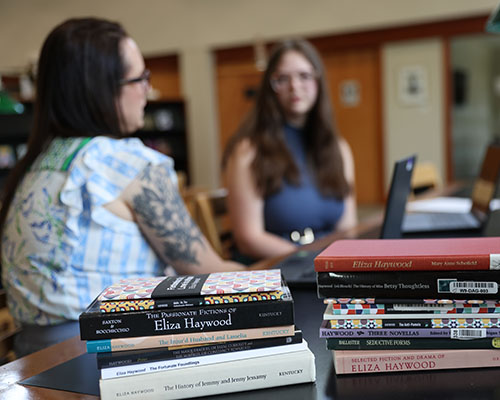
According to George, it isn’t only about applying the tools, but also about whether they can modify the tools to create a reliable outcome for their project and future research.
“We’re starting with an overview of the works, getting all the words digitized as best we can, and then seeing the change of sentiment over the time of Haywood’s writing,” George says. “But then we can look further, dive deeper. We can do analysis by word, by sentence, or by chapter, and look for patterns in her writing. We are modifying the text analysis tools based on her works and may want to apply the same process to other authors’ collected works in the future.”
While the reading-heavy nature of this CSRI project keeps them from having the typical daily schedule, the group meets as a whole once a week and in smaller teams throughout the week. The results so far have been exciting.
“I feel like in the real world, this experience is really impactful because it allows us to change the way that we’re viewing 18th-century literature. It’s providing us a new lens of viewing this process,” Ries says.
By the end of CSRI, the team hopes to have a website highlighting their results. They will include both the biographical and literary results of Haywood’s writings, as well as charts that highlight the data that Wald has collected. They are also considering authoring a paper for an academic journal as they move forward into the academic year.