
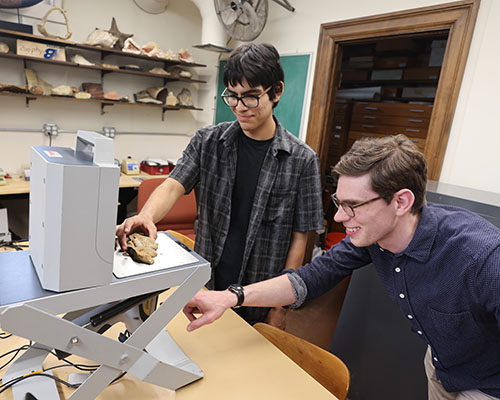
 This year for the Cornell Summer Research Institute (CSRI), one student investigated a 450-million-year-old crime scene where thousands of ancient nautiloids met their end.
Kevin Zazueta ’27 and Assistant Professor of Geology Andrew Walters spent the summer examining a rare mass mortality bed in Graf, Iowa.
Mass mortality beds form when a rock layer holds an unusually high number of the same fossil. Zazueta and Walters investigated one packed with nautiloids—ancient molluscs related to modern squid and octopuses—to uncover what triggered such a die-off in eastern Iowa.
“In this particular site that we're studying for this year's CSRI, we see not just one, but multiple, thick mass mortality beds, each of which contain thousands of nautiloid shells densely packed together. It's a particularly unique and interesting location,” Walters said.
They are the first scientists to research this mass mortality bed in this way, and the results could impact what we know about climate change, the carbon cycle, or changes in oceanic chemistry.
Like any puzzling case, this one has several likely culprits. Shifts in ocean chemistry, sudden geological upheaval, or the gradual accumulation of fossilized remains—all leave their trace at the scene. While any of these reasons could have caused the mass mortality bed, it’s up to these CSRI crime-scene investigators to unravel the evidence.
Solving the mystery
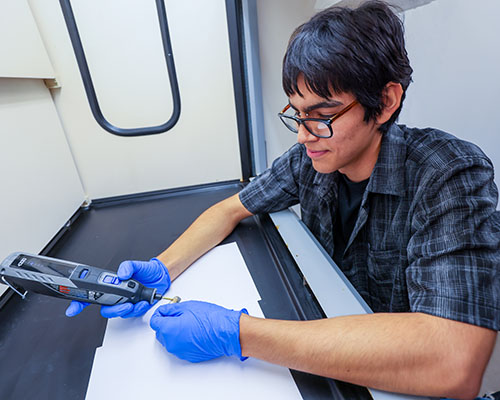
Zazueta and Walters began by examining the exposed rock, treating each layer like evidence at a scene—searching for patterns, anomalies, and potential leads. After narrowing their focus to a twenty-foot stretch, they collected 30 samples—each later cleaned and cut for closer analysis.
“My favorite part of CSRI so far is being out in the field with a hammer collecting samples,” Zazueta said. “I just like it. It’s fun.”
Once all the samples have been collected and prepared, the scientific detectives were ready to evaluate the clues left behind 450 million years ago. Taking the newly cut open rock, they placed it face down into a machine called an X-ray fluorescence (XRF) analyzer.
“This is a tool for measuring the elemental chemistry of the rocks,” Walters said. “These rocks are being deposited in the ocean, and the composition of rocks that are deposited in part reflects the chemistry of the ocean itself. So by looking at the chemistry of these rocks, we can get a sense of potential variations in the chemistry of these ancient oceans.”
Cutting into the rock exposes fresh surfaces—vital evidence for chemical analysis, which offers clues about the environment behind the mass mortality. Additional samples are sent to Iowa State’s Stable Isotope Lab to uncover further insights.
Watch this CSRI research unfold in this video:
Uncovering what happened
This summer, Zazueta poured over the quick-fire XRF data and presented his preliminary findings in a presentation at the end of CSRI. The long-term plan includes revisiting the evidence, layering in isotope results, and building a fuller picture in his senior capstone—perhaps even taking the case to a wider audience at future conferences.
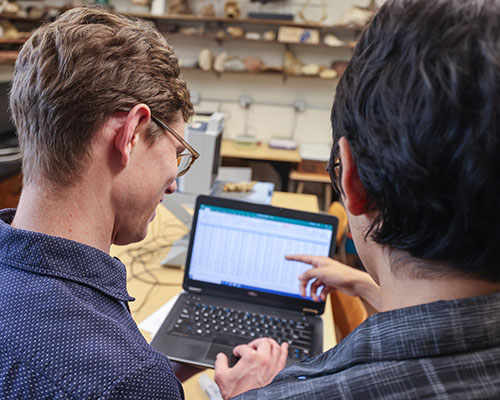 “I’m hoping that this work leads me to find out why these nautiloids were deposited like this,” Zazueta said. “But I am also hoping to gain skills, such as using the XRF gun, different types of software, and even just being out in the field and getting hands-on geology skills.”
For Zazueta, who wants to be a geochemist and continue doing this type of research, CSRI was an important opportunity. Plus, it’s compelling.
“I actually chose Cornell because of its small class sizes, and I knew they were more hands-on with their learning,” Zazueta said. “But as far as this? Like the scale of what I'm doing now? It's just very hands-on. I'm sweating out there. Collecting these samples. Learning these skills. It’s great.”