
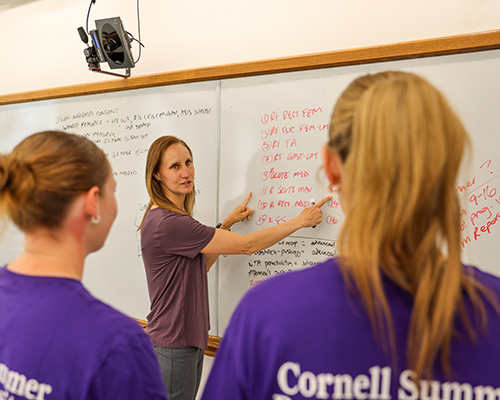
Three rising seniors who hope to become physical therapists explored movement during the Cornell Summer Research Institute (CSRI) to help them better understand injuries and serve their future patients.
“We’re testing core strength, and we’re looking at how someone walks and runs,” said rising senior August Giurato ’26. “We’re looking at how those correlate with lower body overuse injuries.”
For the eight weeks of CSRI, Giurato and his teammates Rylee Vandresar ’26 and Heidi Jorgensen ’26 worked with Professor of Kinesiology Kristi Meyer ’01. Meyer, who has a doctorate in physical therapy and worked in a variety of clinical settings before returning to Cornell to teach, says all three kinesiology majors are interested in the same career path.
“For CSRI, I will take students interested in many areas,” Meyer said. “This year is really unique because we have all three of them interested in physical therapy. It’s fun because we’re all thinking the same way. We have the same type of viewpoint as to what we’re looking at and why it’s important.”
The research team worked with dozens of subjects in Law Hall’s Movement Analysis Lab, which uses state-of-the-art technology to study aspects of human movements. Meyer said researchers have published many papers about the biomechanics of gait, or the way humans move when walking or running, but understanding how core strength plays a role in that movement and related injuries is new.
“As a physical therapist, we are always thinking about injuries and how we prevent and treat them,” Meyer said. “If we know the roles that some of these other areas have in those occurrences of injuries as well as the treatment of them, then it gives us more ideas of what we can do to intervene and help clients.”
Watch this video of the team's kinesiology research
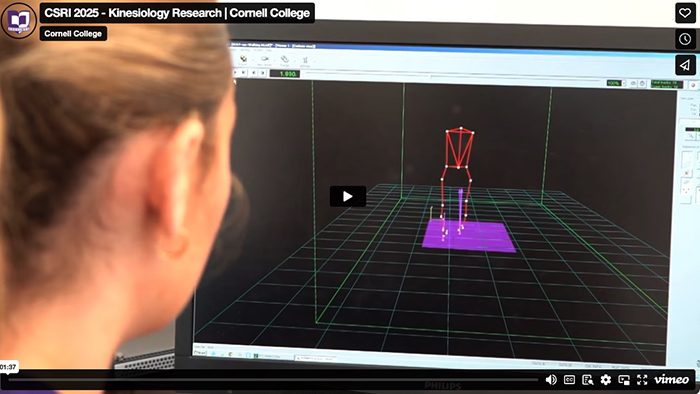
Collecting data
The team developed a plan for testing subjects to collect the data they need. First, they analyzed core and hip strength.
“We’re doing side planks on both sides, and then we’re also going to be doing two tests—one that tests the anterior part of your core and then the posterior part of your core, in addition to tests that measure your hip strength,” Giurato said.
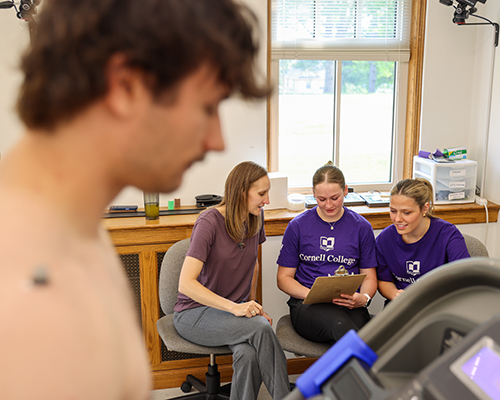 Then, they connected subjects to a variety of monitors so they could closely watch the body’s movements.
“When they are running and walking, we have them connected to 10 EMGs (wireless electromyography sensors), which monitor your muscles,” Vandresar said. “We are seeing during which part of your running and walking gaits different muscles are activated. We also have people connected to reflective markers, and cameras around the room pick up that movement. We’re seeing how everything moves when they walk and run.”
The team worked closely with their professor to solve a problem and collect data that will help them better understand the human body and prepare for their future careers.
“I think it’s awesome just getting to know my professor, specifically. I love Kristi,” Jorgensen said. “She’s been my advisor, and she’s really been helpful to me throughout my time here at Cornell. Getting this extra time with her has been really fun.”
The team completed the research project from start to finish. They tracked and processed their data and added statistical analysis. Then, they presented it for the community during the e-poster event at the end of CSRI.
“To get this type of high-level undergraduate research at an institution like Cornell is pretty sweet,” Meyer said. “I am grateful to be able to offer this opportunity and to collaborate with our students.”