
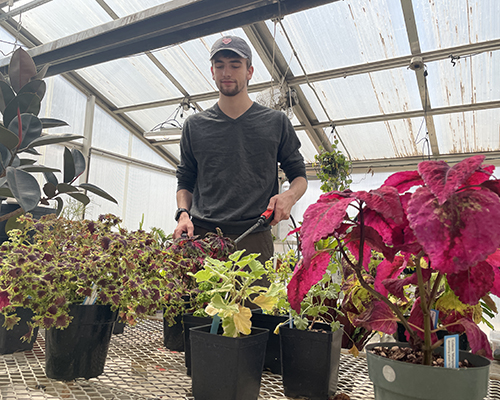
Since Sam Bigalke ’27 arrived on campus, he’s poured his heart into what he calls a passion project—restoring Cornell’s greenhouse.
“I grew up gardening, it’s a hobby of mine, and it’s just something I wanted to do,” said Bigalke, a biology and molecular biology major.
For the past five years, the greenhouse behind West Science Hall has been mostly unused, except for smaller projects and storage. With a lack of plants, no watering system, and issues maintaining warm temperatures in the winter, Bigalke got to work. He received support from Assistant Professor of Biology Josh Otten and Professor of Geology Rhawn Denniston.
“His vision was originally just cleaning it up and getting it operable, and as we chatted more, I realized he had a much deeper interest, had experience working in a greenhouse before, had research experience with plants, and was just driven,” Otten said. “From there, I just told Sam to tell me what he needed, and I would try and make it happen. We did spend a few days together cleaning and reorganizing, but ultimately he did it all.”
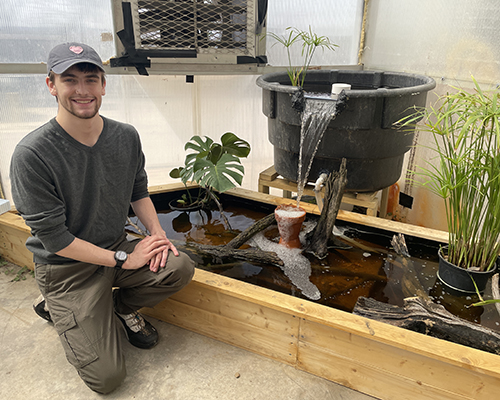
Bigalke and Otten programmed the automated temperature system, winterized the building, bought and installed an automated watering system, and built a turtle pond.
Then, came the plants.
Bigalke secured donations from the University of Iowa and the Greater Des Moines Botanical Garden, plus he donated many of his own plants.
“I kind of just started emailing people and being like, ‘hey, we’re trying to get our greenhouse started back up again, but we don’t have any budget to purchase plant material, would you be willing to donate?’” Bigalke said.
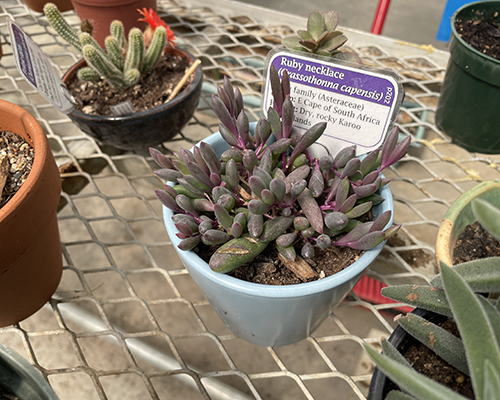
Bigalke received 42 plants from the Botanical Garden and 20 from the University of Iowa. Add in his own plant collection and a few from the biology faculty, and now the greenhouse is home to about 100 plants.
“My main goal with acquiring a plant collection on campus is to make it teachable,” Bigalke said. “In botany, you look at the 10 major plant families, specialization, and adaptation. Then, there’s speciation across a genus. So I wanted one genus where I have multiple plants to show the large variation, even species-to-species. Plus, I wanted to encompass a wide variety of monocots and dicots, and make it so that you can teach a class if it’s too cold for plants outside.”
Bigalke worked in the greenhouse for about 15 hours a week during the school year. His passion project resulted in a work-study job with the biology department. So now, he gets paid to do the work, but he says he works more than he gets paid for, by choice. The Cornell sophomore enjoys fertilizing plants, conducting pest inspection and maintenance, repotting plants, propagating plants, and caring for the turtles in the pond, which was built to mimic an eastern U.S. bog ecosystem.
Bigalke says the larger goal is for more faculty and students to use the greenhouse during cold-weather biology classes, Cornell Summer Research Institute (CSRI) projects, and one day, he hopes to open it up for students to use for studying during the cold winter months.
 “Sam is an extremely efficient single-person team,” said Otten, who has a long-running turtle research project. “He has been putting together a manual with care guides, troubleshooting for the infrastructure, and how to program everything so that in his absence, it could be passed onto another student to run. I couldn't have asked for a better person to kickstart this project, and I’m extremely grateful that he had a clear vision.”
The greenhouse is all set for the summer as CSRI teams already plan to put it to use, and Bigalke sets out to travel to Maine to tackle his next project related to his future dream job in evolutionary genetics.
“I’ll be working in an evolutionary genomics lab at Jackson Laboratory in Bar Harbor, Maine,” Bigalke said. “Specifically, I’ll be looking at the accuracy of inbred strain mice as a model species for researching human diseases. And I’ll be conducting my research under Dr. Beth Dumont.”
After his research in Maine, he’s planning to reunite with the greenhouse next fall and is excited to see how the plants and the facility continue to grow next year.