
Note: This is a guest article written by Associate Professor of Kinesiology Lewis Kanyiba. He holds a Ph.D. in physical education–teaching and administration and has been at Cornell since the fall of 2020.
Senior Carissa Meis ’25 and junior A’ryn Jackson ’26 presented their research, “Playgrounds as an Ecological Affordance for Early Childhood Motor Learning” at the Iowa Parks and Recreation Association annual conference.
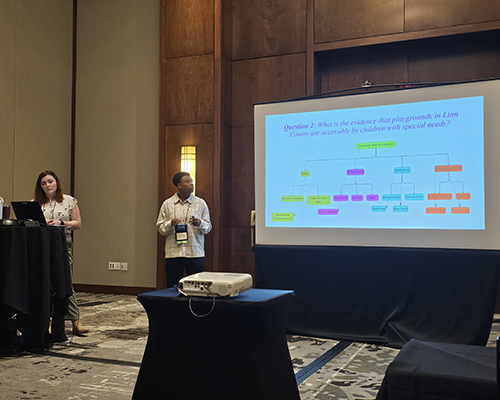
Carissa Meis ’25 (left) and A’ryn Jackson ’26 presented their research at the Iowa Parks and Recreation Association annual conference.
It was held at the Hyatt Regency Coralville Hotel & Conference Center in Coralville, Iowa, on May 27.
Meis, an elementary education major, and Jackson, a kinesiology physical education and health promotion major, worked with two additional student researchers—Ani’ja Simmons and Kaylynn Sparks—to conduct the research through the Cornell Summer Research Institute (CSRI) in 2023. The study was necessitated by a gap in literature and inventory of playgrounds located within Linn County parks and school districts. It was a mixed-methods descriptive study that used stratified sampling to study the ecological affordance of 113 public playgrounds in all 15 cities in Linn County, Iowa.
For quantitative data, the independent variables included the location—park and school—and population density—urban, suburban, and rural. The dependent variable was the average score in five categories of physical fitness affordance score, including aerobic capacity, strength, endurance, balance, and flexibility. The rating ranged from 1, meaning the playground had one to no equipment for that fitness category, to 5, meaning it had more than seven pieces of equipment for the fitness category.
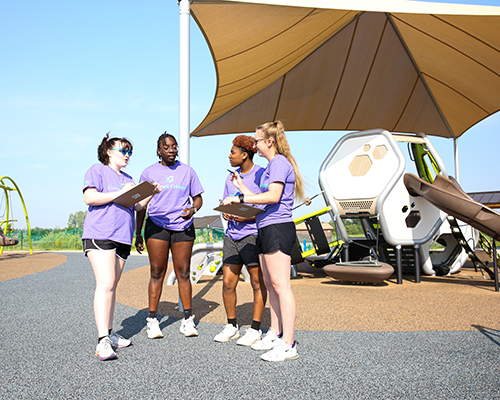
As their faculty sponsor, Associate Professor of Kinesiology Lewis Kanyiba was motivated by his love for working with children and his research in youth sports.
“One of the most recognizable structures in the world is a playground,” Kanyiba said. “We all associate playgrounds with children. It is a place that children often recognize as their personal space, solely designated for their enjoyment.
Playgrounds are found in a variety of settings including parks, schools, restaurants, and entertainment places. What’s common about all these spaces is that adults also congregate there, and playgrounds are expected to be a reserve for their accompanying children. While to most people this facility keeps children “busy” while allowing adults to carry on with their business, some parents and caregivers deliberately expose children to playgrounds as a means of recreation, exercise, and as opportunities to develop and maintain friendships.
“Children should acquire movement competencies during early childhood, and just like strong literacy skills prepare students to excel in subsequent grades, it enables them to be competent movers in adulthood,” Kanyiba said. “Movement competency includes overall physical fitness and learning to move in a variety of ways. It also includes enhancing all the six senses. Specifically, the ability to see, hear, touch, and proprioception significantly aid motor actions.”
Results:
Parks playgrounds (N = 75; 64%) had a mean rating of 3.61 (SD = .94). Schools’ playgrounds (N = 41; 36%) were in slightly better condition compared to parks with a mean rating of 3.66 (SD = .69). Urban playgrounds (N = 51; 45%) with a mean rating of 3.65 (SD = .63) outperformed suburban playgrounds (N = 45; 40%, M = 3.62, SD = 1.09) and rural playgrounds (N = 17; 15%, M = 3.59, SD = .80). Overall, Linn County playgrounds (N = 113; 100%) are in fair condition (M = 3.63, SD = .86).
The study also qualitatively evaluated the safety and accessibility of the playground for children with special needs. The emerging themes for accessibility included mobility (ramps, open spaces), auditory system (gramophone, chimes, jingles, etc.), visual system (demo charts, bright colors, behavior charts, etc.), and somatosensory system (textured equipment, tactile puzzles, adaptive swings, etc.). The emerging themes for safety included location (fence, CCTV cameras, posted rules, etc.), cleanliness (equipment, air, running water, etc.), stability (ladders, bridges, non-rusty accessories, etc.), and shades (natural, pavilion, and over-equipment shades).
Conclusions:
“I have always considered undergraduate research as a privilege and a challenge accepted by a few motivated students,” Kanyiba said. “The four students definitely exceeded my expectations! Conceptualizing a study within the eight weeks of CSRI, seeking consent from relevant authorities, collecting and analyzing data, and sharing the results with the Cornell and Mount Vernon community through the Student Symposium was an incredible milestone not only for our students but also for me as their faculty sponsor. This project has a strong link to the community, and it has been shared in other forums including local radio and newspaper articles. I knew that this quality research would be well received at any level for both presentation and publication, and I am so proud that two of our student researchers applied and got accepted to present at such a relevant state conference. Watching them present, answer questions, and engage with individual attendees, who had very constructive feedback, was probably the most satisfying part.”
There is now a YouTube channel, @IowaPlaygrounds, showcasing this research, acting as a guide to parents and caregivers seeking appropriate playgrounds for their children. The team is looking forward to publishing in the Journal of Park and Recreation Administration.