A market fluctuates. A supply curve falls. Interest rates are cut. Prices go up. Things change. People react. Economists tell us what those changes mean.
It’s fitting, then, that Cornell’s Economics and Business department is undergoing some changes of its own.
“There is an ebb and flow, and things change around the margins,” said Professor A’amer Farooqi. “But things have not changed that much around here.”
The truth is, things have changed. It’s the core, educational mission– one of critical thinking, logical progression, problem-solving, and theory applied to the real world–that hasn’t.
Those margins to which Farooqi alludes are no small matters. The Berry Center for Economics, Business, and Public Policy. A new professor in public policy, shared with politics, and another in finance. The retirement of long-time professors Don Cell, Gordon Urquhart, and James Stout. Even changes in the curriculum.
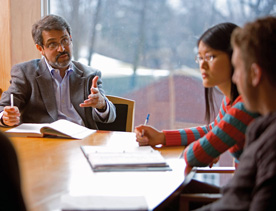
Professor A'amer Farooqi joined the economics and business department in 1987 and now directs the Berry Center for Economics, Business, and Public Policy.
But Farooqi’s sentiments speak to the focus of the department. While the tools have modernized, improved, and gotten shinier, their goal is still the same.
“Specific knowledge is not as important as approach. We want people to leave being able to think critically,” said Associate Professor Todd Knoop. “The benefit is that economics is a method of the mind. It’s an effective way of looking at the world.”
Professor Jerome Savitsky added, “I would like our students to have strong analytical skills, strong problem-solving skills, and strong empirical skills.”
“Notice,” he went on, “I haven’t mentioned strong economic skills.”
“Don Cell retired [in 2000], and, in many ways, he defined the department. Stout and Urquhart too,” said Farooqi. “When you change personnel, sometimes the fields get more emphasis.”
Prior to the early 1960s, the department had emphasized business and secretarial training over economics. Cell and Stout, though, were part of a restructuring and expansion of the department in the early 1960s under Robert Bunting, then the chair of the department, which placed a greater emphasis on economics and theory, while downplaying courses in accounting and finance.
Cell retired in 2000, but by then he had already spent a good deal of time with Stout (who started in 1981), Urquhart (’84), Farooqi (’87), and Knoop (’98). The emphasis on economics that began in the 1960s, therefore, continues to drive the department.
And while that emphasis is unlikely to disappear anytime soon—Farooqi, Knoop, Savitsky and Assistant Professor Santhi Hejeebu are all Ph.D. economists—the influx of two new professors for the 2008–2009 year and the advent of the Berry Center have created new opportunities and new challenges.
“Two things define the department,” said Farooqi, “the model of undergrad education and the Berry Center.”
That model of undergraduate education is founded in solid theory work backed up by applied analytical skills. The idea of a liberal arts economics education isn’t to simply churn out future management and MBAs (though many do go on to succeed in those areas) but to create students capable of succeeding in many areas.
“We’re not a trade school,” said Hejeebu. “Our focus is on applied theory.”
“The rationale is that we live in a globalized economy characterized by rapid technological, social, and cultural change,” said Farooqi. “The average person will change careers many times. It is therefore essential that they have the ability to acquire new skills and remake themselves in a new manner.”
In that vein, each professor places a strong emphasis on lecture and class work. Savitsky defined his teaching style as “lecture, exam, problem set,” and several of them described their teaching styles as “traditional.”
“Economics has a reputation for being one of the more challenging departments on campus, and that’s a reputation we’re proud of,” said Knoop.
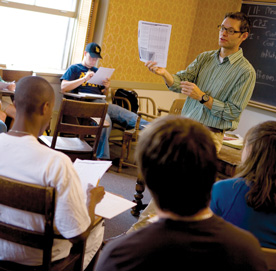
Professor Todd Knopp leads class in College Hall. Knoop is publishing his second book this spring.
Ask any of ECB’s students, however, and they’re likely to add a third point to Farooqi’s two-pronged definition. ECB is really, really hard.
“It’s the combination of abstract theory, mathematics, and the real world interactions that make it tough,” said Junior Audrey Saunders. “Intermediate Microeconomics is supposedly the hardest class on campus. I’ve heard stories of students taking sleeping bags to the labs and saying they stopped showering after the first week.”
Hygiene aside, it’s that level of dedication that leads Junior Jeff Curran to rave about the department—full of students he describes in one word as “committed”—and the rigorous coursework the professors put them through.
“The staples of ECB—Intermediate Micro and Macro—are really tough. I’d put them up against any other class I’ve taken here at Cornell,” said Curran.
“But in a positive way,” he added.
ECB students seem to share Curran’s attitude toward the challenge almost universally. Savitsky said Intermediate Microeconomics is a course most students claim to actively dislike, “but get the warm fuzzies about four or five years later.”
Senior Jamie Adams may already have those warm fuzzies. “All the professors hold you to a very high standard. They’ll push you as hard as they can, but,” she adds, “they’ll help you along the way.”
The foursome, for their part, recognize and, in a way, revel in their reputation.
“It’s not that we’re SOBs, but we’re demanding of our students. And we’re proud of that,” said Savitsky.
“The Berry Center has injected new energy and life into this department,” said Hejeebu. “It lets us bring people on and take students off campus in ways that weren’t possible before. It has made us more outward looking.”
If there’s one thing the department isn’t shy about, it’s its commitment to theory and logic over real-world examples inside the classroom. However, The Berry Center — shared with politics — has altered that equation since its inception in 2004.
“The essence of the Berry Center,” said Farooqi, “is that it’s an ambitious academic enrichment program.”
“The Berry Center enables students to see how economics works in the real world and how to do it in the real world,” said Knoop. “We’ve been able to bring in visiting scholars and lecturers, and experts just for class. The Berry Center has supported a reading group and enabled Santhi’s Newberry Library trip.”
The Newberry Library trip exemplifies what the Berry Center has been able to do for experiential learning in ECB. The class– Enterprise and Entrepreneurship in U.S. Economic History—took students to the famed Newberry Library in Chicago to study business documents firsthand. The students studied the Pullman Railroad company from the start of the 20th Century.
“This is a really ambitious class. It’s original works in history, developing the quantitative skills to study any time or any industry,” said Hejeebu.
“To understand it you really need to go back in time. Pullman railroad cars kept two sets of books, one for their stockholders and one for government regulators. It allows you to see things that you can’t see today. These documents weren’t meant for our eyes,” said Hejeebu.
The students were not only at the library handling documents that were 100 years old, but they were visiting the old Pullman yards, exploring the history of the company throughout Chicago, and doing interesting, original research.
“There are all sorts of freedoms with a class like this,” said Hejeebu. “You’re in the driver’s seat. You’ve got the facts. It’s an example of our new emphasis in applied economics. Economy applied to the study of history.”
The best part? The cost for students to spend four days in Chicago: only $50–$75 per student, the rest funded by The Berry Center.
Opportunities like this, which were once few and far between, are now abundant for any student who wants them, especially for the student willing to look outside the classroom.
With connections “everywhere,” Berry Center Coordinator Monica Davis ’02 has found success helping both politics and ECB students find dream internships.
“Finding opportunities isn’t the hard part,” said Davis. “It’s identifying and preparing the student for the experience.”
Those experiences have taken ECB students all over the place. Sophomore Kevin Pickhard, for example, was a Cornell Fellow for the Houston Astros in the winter of 2008.
Adams, who ambitiously wants to own her own record company some day, gained valuable experience interning with Z102.9/ESPN 1600 radio in Cedar Rapids.
“The Berry Center was extremely helpful. They had the contacts and made sure I had funding and things like that,” said Adams. “The classes teach everything you can do academically. But the real world requires experience, or they won’t even look at you. It’s opened a lot of doors for me.”
Junior Ben Siebers spent his summer at the Cedar Rapids Bank and Trust Company, which he said was “like a financial accounting class.”
“I was able to take what I learned in class,” he said, “and put it into some of the projects I was doing for them.”
Senior Kirstin Willard traveled all the way to Montevideo, Uruguay, in the summer of 2006 to work for a brokerage house registered with the Uruguayan Stock Exchange, RenMax Sociedad de Bolsa. Not only did Willard have what she called “a life-changing experience,” but the internship opened up another doorway for the Berry Center. RenMax created another spot for a Cornell student in the summer of 2008.
These extraordinary opportunities, through the Berry Center and otherwise, make ECB stand out, not just on campus but across colleges and universities.
“It’s uncommon for a liberal arts college to have a substantial endowment to support academic enrichment in targeted disciplines,” said Farooqi. “It really is unusual and distinctive.”
Unusual and distinctive. Sounds right up their alley.