Thirty years ago, a little company called Apple was born. Spain was just discovering Democracy in 1978, while America was discovering Diff’rent Strokes and Gary Coleman. Three decades ago, Garfield debuted in the funny pages, the Blues Brothers showed up on Saturday Night Live for the first time, Annie Hall won best picture, John Paul II was a freshman Pope, and Jimmy Carter held that other job he had before becoming ambassador extraordinaire.
And it was way back in 1978—back when Pete Rose was a national hero and the U.S.S.R was a force to be reckoned with—that Cornell College adopted One Course At A Time. Put another way, One Course At A Time falls between “Begin, Reagan, Palestine, terror on the airline” and “Ayatollah’s in Iran, Russians in Afghanistan” on the Billy Joel timeline of world history.
Suffice to say, things have changed a bit since then.
And while the outside world was busy changing, One Course At A Time was busy adapting to that world. One simple idea—take one class, every day, for a month and then move on to the next one—has transformed into a culture, a way of life and education, and a community-wide way of approaching liberal arts education.
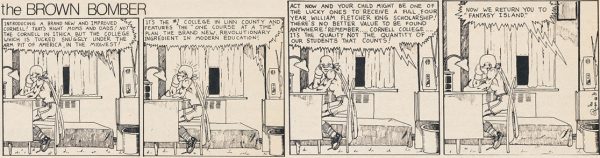
Rupert Kinnard '79 created this "Brown Bomber" comic strip for the Jan. 30, 1979, edition of The Cornellian.
This is the story of 30 years of One Course At A Time.
History of One Course At A Time
The Rev. Richard Thomas is an impeccably effortless storyteller, on this day or any other. He relaxes in the Cornell library, coffee in hand, and pulls facts from decades ago as if it were yesterday. Thomas arrived at Cornell in 1967 and officially retired in 1996, but has continued to teach every year since.
The mood in 1977, as he tells it, was anxious. Enrollment projections forced administrators to consider a sustained enrollment of about 650, a low not seen since World War II. Money was tight. Push had come to pull. Either changes needed to be made, or the college had to accept a new reality.
Into that environment stepped Robert Lewis, who had become dean of the college in 1975. Lewis was familiar with the block plan employed by Colorado College and sent several faculty to study it. The response was immediately positive.
“The idea arose when people were quite pessimistic about the college,” said Craig Allin. Students were being lost to community colleges, especially incoming 18-year-olds.
The idea gained traction and, during the fall of 1977, became the focal point of campus debate. Everyone had an opinion.
From a marketing standpoint, the move to One Course At A Time gave the college a “point of difference.” The college performed some market research and found that this one point of difference could mean a world of improvement.
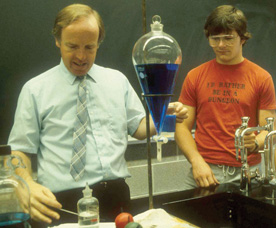
Truman Jordan, professor emeritus of chemistry, taught both before and after the block plan. His early work helped create the modern template for how laboratory experiments are done on the block plan. Here he's shown demonstrating a lab to his students.
“We found that, of the students interested in Cornell as it was, one-third were indifferent, one-third preferred [One Course At A Time], and one-third didn’t like it,” said James Day, who was the director of public relations starting in January of 1977.
“But now,” added the founder of higher education consulting firm Hardwick Day, “we were only one of two schools who had this plan.”
To administrators, this meant a leg up on students who were in the one-third of recruits who found the calendar advantageous, leading to, theoretically, greater enrollment.
To faculty, however, concerns were pedagogical.
“It wasn’t simply a philosophically driven idea, because no one had been able to prove it was better than the quarter or semester system,” said Thomas.
“The interesting thing about this was that a lot of the curricular discussions got caught up in what was the true nature of the liberal arts,” said Day. “What was transformative about this discussion was what was true liberal arts to what was most effective pedagogy.”
The faculty split into two camps. Music, math, and the sciences generally lined up against the program, worried they couldn’t adequately cover their subjects in only a month. The social sciences and the humanities, on the other hand, generally found the depth of the system enticing.
In the end, the faculty voted nearly two-to-one to adopt One Course At A Time, splitting largely down generational lines rather than departmental.
“One Course At A Time was adopted by associate and assistant professors over the objections of full professors,” said Allin.
Eventually, of course, those associates and assistants, like Allin himself—who now heads the politics department—came to be full professors in their own right. Only now they had a new system to work with.
The changes were implemented for the very next school year, 1978-79. Yet among the faculty, things still were not quite settled. Some took early retirement or left entirely, convinced the system would fail. Others who voted against the proposal stayed on.
Either way, by the 1984–85 school year, the faculty had mostly settled in. Those who stayed realized the promises made in the debate, and then some. The enrollment issue dissipated with the new system, as the student population topped 1,000 for the first time in the college’s history and continued to set new records into the 1990s. Today, the incoming class is one of the largest the school has ever recruited.
But the change was far more than cosmetic.
"Something different was happening"
A popular off-campus study destination is the Bahamas field station ,where biologists can investigate sea life, geologists can examine underwater rock formations, and scientists of all kinds have weeks of genuine, uninterrupted professor-directed research. (Photo by Benjamin Greenstein)
“After a year of trying it out, it became apparent that things didn’t just collapse,” said Thomas. “Something different was happening.”
That something different was the realization of all the promises made during the debate. The arguments in favor of the block plan not only came true, but began to define the Cornell experience during the next 20 or so years.
“The biggest discovery I made about One Course At A Time,” said Allin, “was that over time I came to appreciate that I could plan the calendar around the course rather than the course around the calendar.”
That sort of flexibility was one of One Course At A Time’s strongest selling points early on, and continues to be so. In fact, that flexibility is one of the primary reasons Quest University modeled its calendar after Cornell’s (see “Imitation is the sincerest form of flattery”).
In the first years after the switch, that flexibility meant daylong geology fieldtrips, combinations of classroom and practicum activities in education, architectural tours around the Midwest, and internships taken nearly any time of the year.
Even while staying on campus, professors found their interactions with students to be deeper and more fulfilling. Allin said he actually doubled the number of contact hours with students in some of his classes, and now feels he couldn’t move any of his classes to a semester system without losing the things that make them effective courses.
Professor of Biology Robert Black, who experienced teaching on the semester system before coming to Cornell in 1987, found the student-teacher experience far more rewarding.
“There are conversations and interactions on the block plan I never got to have on the semester plan,” said Black. “That bond inspires students to work harder than they ordinarily would have.”
Not only do the students work harder, according to several professors, but without other classes serving as distractions, students actually become more interested in classes they may normally gloss over to “steal time” from classes within their major.
Allin said that prior to One Course At A Time his introductory classes would often be taken by pre-med students who, despite being some of the brightest in the school, were often his worst students. These students would borrow time from his class to supplement the time they needed for classes in their major. Once the block plan was implemented, suddenly that same type of student became his best, and they often found a love of politics in place of the mild disinterest they had before.
“The focus gives a leg up to achievement-oriented students and the intellectually curious,” said Vice President for Enrollment and Dean of Admission Jonathan Stroud, who added that students who were individually motivated typically found the block plan suited their needs better than a semester system.
The more things change, the more they stay the same
In the past decade or so, a period most attribute directly to President Les Garner, Cornell has evolved and expanded its commitment to utilizing the many strengths of One Course At A Time. The most obvious example is off-campus opportunities. While the inception of One Course At A Time increased such opportunities almost immediately, the last decade has seen an astronomical rise.
Today, it’s nearly impossible to graduate from Cornell without studying abroad, taking a block off for an internship, or simply traveling with a class to one of many established field stations. Off-campus study has gone from a perk of the calendar to something built into it intrinsically. It’s a part of the Cornell experience.
Another part of that experience has been the creation of the centers and programs: The Berry Center, Dimensions, Cornell Fellows, and others. Each of these programs emphasizes off-campus study and experiential learning, and each one is funded by donations from alumni. The college has, in recent years, thrown its weight and money behind these types of opportunities.
“There has been much better institutional support,” said Black, “not just for student studies, but for classes to take advantage of the block plan.”
Black’s observation speaks to the overarching adaptation the college has made as a whole. After 30 years, Cornell really knows how to teach and learn on the block plan.
For example, students who want to go to law school don’t just take the required classes. They’re assigned a pre-law advisor through the Cornell Pre-Law Program. That program funds and hosts activities and extracurriculars all year round.
And pre-med students don’t just learn during the pre-selected lab times. They go back to the labs throughout the block, as professors have the ability to leave them intact for the length of the class. Then, those students can find guidance on entrance exams and meet with alumni doctors through Dimensions.
In fact, faculty have adapted their style so much that, like their semester system brethren before them, many couldn’t fathom teaching on another calendar.